.svg)


You can build a perfect revenue process and still miss your number.
Across running and growing four SaaS scaleups ($1M-$100M), I’ve built multiple sales playbooks. I watched too many good ones die. It didn’t matter how well they were structured; executing consistently was a pipedream. The playbooks that work have one thing in common: they’re designed to run, not just get read.
Why Your Sales Playbook Still Matters
Before we get into what's broken, let’s be clear about what isn't: your playbook is not the problem. The 2025 Brooks Group report confirms it: process adherence drives revenue. Yet, despite knowing this, the average SaaS company still struggles with a 30% playbook adoption rate. Why is there such a massive gap between what works and what reps actually do? Because we keep building playbooks to be read, not to run.
Why Bad Execution Kills Your Sales Playbook
I've seen one pattern consistently across scaling revenue teams: RevOps builds a rigorous process with a real ICP, refined exit criteria, and messaging that actually maps to buyer pain. Reps acknowledge it as valuable and train on it. Within a few weeks, they go back to how they did things before.
This is not a “bad rep” problem. This happens because there’s a structural disconnect between the playbook and the execution. The playbook lives in a siloed drive folder somewhere, but the work is happening in Slack, Gmail, and the CRM.
We saw one of our early customers, a seven-rep enterprise sales team, run into this problem. They had a strong RevOps function with a solid playbook. It had MEDDIC methodology, clear stage definitions, and specific stage exit criteria. But CRM updates were sporadic. Meeting prep came from memory. Follow-ups were generic and late. 70% of rep time was already going to admin work, and pipeline suffered as a result.
This isn't an outlier. Static playbooks lose rep trust and get ignored shortly after rollout. The mechanics are predictable: the playbook swells with training content, onboarding material, and edge-case guidance until it's too unwieldy to navigate during a live deal. Reps improvise. Managers coach on instinct because the system isn't generating reliable data. And when you miss the number, you can't explain why, because your process wasn't actually running.
5 Design Decisions that Impact Playbook Execution
Most playbook-building conversations focus on content: the messaging, the personas, the objection handling, etc. All of that is necessary, but not at the expense of the decisions that determine whether a playbook actually runs. These decisions happen at the design level, not the content level. Start with these five:
1. Start with exit criteria, not content.
The most common playbook design mistake is front-loading content and treating stage progression as an afterthought. Flip it. Before you write a single message template or objection-handling guide, define what has to be true—verified, not assumed—for a deal to advance from one stage to the next.
Exit criteria aren't just a forecasting discipline. They're the architecture that makes automation possible. When you define the conditions that trigger stage movement, you've defined the conditions that trigger action. That's the foundation of a self-executing system.
2. Map every handoff moment.
Go through your playbook and ask a single question at each step: who has to remember to do something here?
Post-call CRM update. Follow-up email. Next-step scheduling. Manager escalation. Each of those moments is a place where execution depends entirely on human memory and discipline. List them explicitly. That list is your automation roadmap. Those are the points where a well-designed system eliminates the memory requirement altogether.
3. Separate the playbook from the training material.
This is a structural failure I see constantly. The playbook tries to be three things at once: an onboarding manual, an operations guide, and a real-time execution tool. It ends up doing none of those things well.
Reps need an execution layer they can actually run live deals with. So it should contain only what they need to act right now. Everything else belongs somewhere else. If your playbook requires more than a few minutes to navigate during an active deal, no one will use it.
4. Build for approval, not autonomy.
This is the design principle I see most often misunderstood when teams start thinking about AI in the sales process. The goal isn't to remove humans from the process. The goal is changing what humans have to do.
A rep shouldn't have to remember to write the follow-up email. But they should approve it before it sends. They shouldn't have to manually update the CRM from memory. But they should confirm the pre-filled record is accurate. The distinction matters for adoption, for trust, and for the quality of the output. I want a rep who owns their pipeline, not one who's been cut out of it.
When I think about AI governance, the right bar is this: can the rep tell you why that action was taken? Not "the model said so." The rep should be able to say "I approved this because..." If they can't, the system isn't working.
5. Instrument it from day one.
If you can't measure whether the playbook is running, you can't improve it. Before you deploy, define leading indicators like messaging adoption rate, stage-to-stage conversion velocity, and rep admin time. These aren't vanity metrics. They're the feedback loop that tells you whether execution is actually happening.
Playbooks that Get Read vs. Playbooks that Run
Stop Asking Reps to Follow the Playbook
The playbook question I hear most often is this: how do we get reps to actually follow it?
Ask a better question instead: how do we design a playbook that doesn't require perfect compliance to work?
That's the question we built Chief to answer. When we onboard a new customer, we don't start by asking them to change their playbook. We start by letting them build their playbook into the platform. Users tell Chief what to do, when to do it, where to get the context, and who to send it to for review.
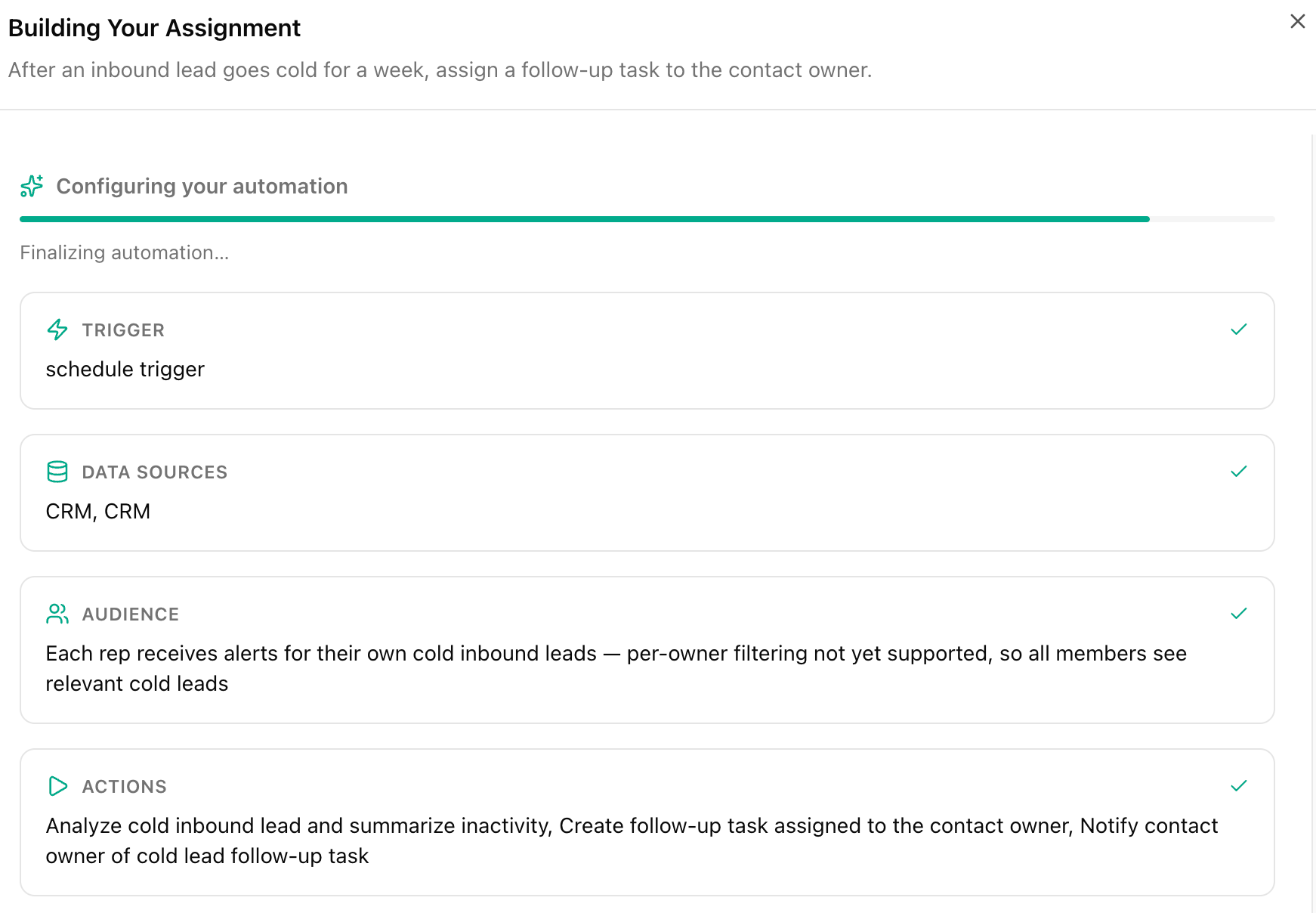
Back to that 7-rep team I mentioned earlier. Once Chief was running, meeting prep was delivered before every call. CRM updates were drafted automatically post-call and queued for rep approval. Follow-ups were ready within minutes of hanging up. Rep admin dropped from 28 hours a week to 16. That’s 43% more time they can use to close deals.
They didn’t have to change their playbook. They just needed it to run itself.
Learn more in our guide to closing rep performance gaps.