.svg)


In 2017, Microsoft had a coaching problem.
They needed to do a better job at meeting their customers’ needs, so they decided to restructure the sales org. But they had more than 20,000 salespeople across 100 countries. That’s a major initiative. Leadership didn't respond to this challenge by reviewing call recordings or running coaching certifications.
Instead, they started with a diagnostic question: what are our high-performing reps actually doing differently?
Using their analytics tools and CRM data, they correlated rep behaviors with sales outcomes and found something that wasn't visible in quota attainment numbers alone — teams working high-growth accounts were engaging twice the number of contacts and collaborating double the time compared to teams on lower-growth accounts. The performance gap wasn't a mystery once they had the right signal.
If you’re running a revenue team, this situation may sound familiar. Your managers are coaching. They're running weekly 1:1s. They're reviewing call recordings. They're pulling pipeline reports and asking the hard questions. And your mid-tier reps haven't moved in three quarters.
You've tried accountability. You've tried new frameworks. You've tried bringing in outside training. The numbers don't move.
This guide is about solving that coaching problem.
Why the Performance Gap?
The macro context matters here because it explains why this problem is getting harder, not easier, to ignore.
Many quota targets are structurally aspirational rather than operationally grounded. Only 25–28% of B2B sales reps hit quota in 2024, down from 44% in 2022 and 53% in 2012. In the same period, 91% of organizations missed their overall quota expectations—including teams with strong average performers dragging a weak middle.
The rep performance gap isn't a recruiting problem or a motivation problem. It's a development problem that most organizations don't have a systematic way to solve. The gap between top performers and middle performers has always existed. The problem is that it's widening, it's expensive, and fixing it through coaching alone isn't working the way it should.
What the Coaching Gap Is Actually About
The conventional diagnosis is that managers don't coach enough. The data supports this: 73% of sales managers spend less than 5% of their time on coaching. 38% of Reps say they are rarely coached, and 14% never get any coaching—even as 90% of managers believe they're coaching at least monthly.
The time problem is real. The average manager's direct report count has grown from 10.9 to 12.1 in a year (an 11% increase), creating more demands on their time. Simply finding room in the schedule is challenging.
But the time argument misses something important: when managers do coach, it's often not working. 72% of sales reps say they don't receive specific, actionable feedback from their managers. You can double the frequency of coaching sessions and still get the same result if the underlying diagnosis is wrong.
The deeper problem is what managers are coaching from.
In most sales organizations, 1:1s default to deal inspection. One analysis found that coaching conversations become deal reviews with only 5% of the time actually spent on useful feedback about the rep's development. They discuss the deal, suggest tactics for the next call, and that’s it. The behavioral pattern that's been holding them at 72% quota stays uncovered.
Sales leaders agree that coaching influences quota attainment. Nearly all of them believe they're already doing it. But the way they’re doing it isn’t working.
The Coaching Signal Problem
When Microsoft dug into their Salesforce data, they weren't looking at call quality scores or activity logs. They were looking at behavioral patterns: how much time reps spent with different accounts, how many contacts they were engaging across the buying committee, how collaboration time correlated with satisfaction and growth. The behaviors that separated high-growth account teams from low-growth ones weren't visible in quota attainment data. They only became visible when the team started measuring what reps were actually doing inside deals.
This is the version of the problem that most coaching conversations never reach. There are two fundamentally different types of coaching signal, and most managers only have access to one of them.
Call-Level Signals
The first type is activity and call-level signals: calls made, emails sent, talk-to-listen ratio, meeting frequency, call recording review. These metrics are important and shouldn't be ignored. But make sure you’re clear about what they tell you. They signal how hard a rep is working and how they're communicating, not where their deals are actually breaking down. A rep can have perfect talk-to-listen ratios on every call and still watch 60% of their pipeline stall in mid-stage.
Deal-Level Signals
The second type is deal-level behavioral signals: stage conversion rates by rep, how long deals sit in each stage, whether reps are reaching the economic buyer, whether they're building multi-threaded relationships or single-threading through a champion. These patterns live in the CRM. It’s what reps actually do inside deals, not what they say on calls. And they're almost always the signals that explain the performance gap.
On a single call recording, a manager can help the rep improve their technique. But they run the risk of coaching to a one-off error. If a rep is making an error consistently and repeatedly, that’s a more impactful coaching opportunity.
That failure to diagnose is almost always a signal failure, not a coaching failure. The manager isn't incapable. They just don't have the data that would tell them what to coach. That’s why deal-level behavioral signals are so critical.
A Coaching Framework That Actually Moves Performance
Good sales coaching requires the same thing that good sales does: diagnosis before prescription. This four-step framework below is built around that sequence.
Step 1: Diagnose with Data
Before any coaching conversation about rep performance, a manager needs a clear answer to one question: what specific behavior is creating the gap between this rep and your top performers?
Not "they need to be more confident in discovery." Not "they're not following up fast enough." A specific, measurable behavioral delta. For example, “your discovery-to-demo conversion is 14 points below benchmark, let’s find out why.” “Your economic buyer access rate is 31% versus the team average of 67%,” “your average time in stage 3 is 22 days versus 11 for your top performers,” etc.
That level of insight requires more than a call review. It requires pulling stage conversion rates, deal velocity, and other benchmarks, then identifying what your top performers actually do. The gap you find between top performers and the rest of the pack is what you coach.
Step 2: Prioritize Ruthlessly
Not all coaching investment returns the same result. High-quality coaching can improve the performance of the middle 60% of sales reps by up to 19%, depending on the quality of diagnosis and execution. The same research found minimal impact on the top 20% (who are already operating at their ceiling) and the bottom 20% (who often have different problems that require different interventions).
This means your coaching time has an optimal target: the mid-tier reps who have both the ceiling to move and the coachability to respond. Spend as much coaching time as you can with the eight reps who've been hovering at 70–80% quota for three quarters—those are the ones where an hour of well-diagnosed coaching can move the number.
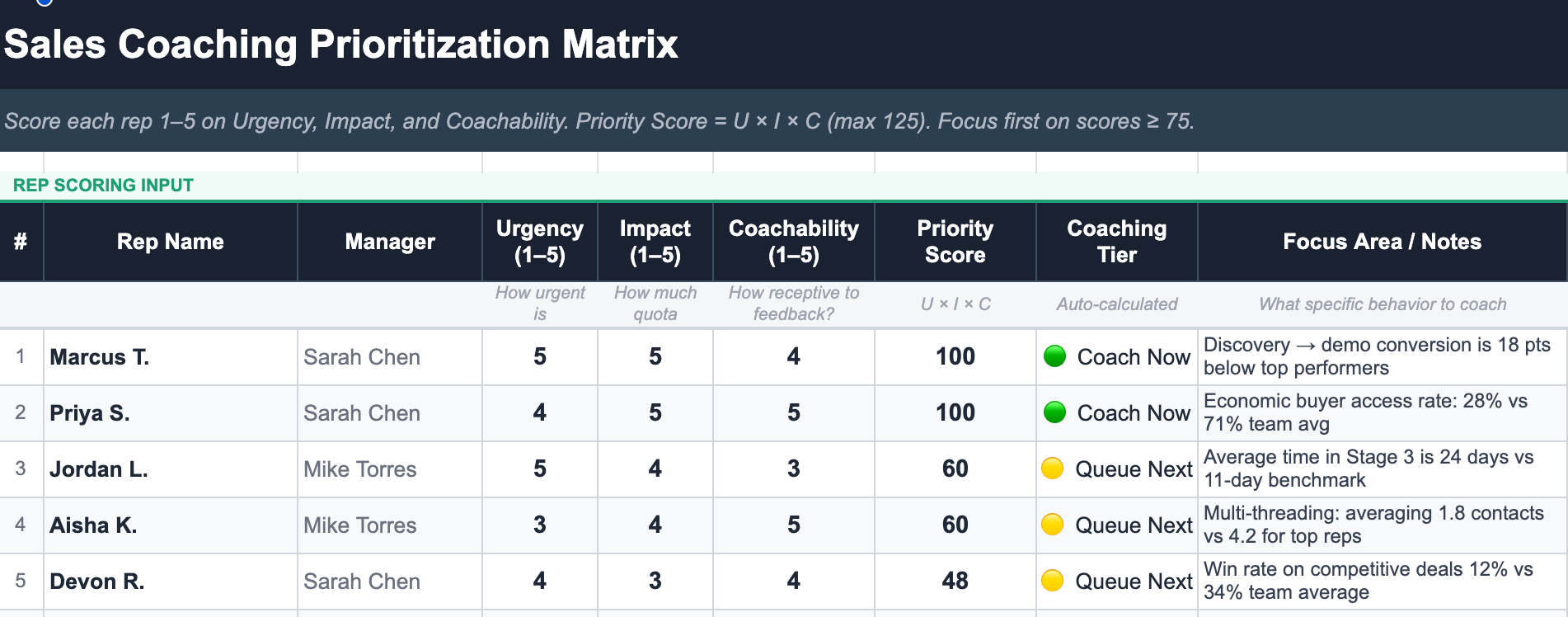
A useful prioritization tool is the urgency × impact × coachability matrix: score each rep on how urgently their gap needs to close (given pipeline and quota pressure), how much quota impact closing that gap would create, and how receptive they appear to coaching based on past sessions. That gives you a coaching queue, not just a coaching aspiration.
Step 3: Coach One Thing at a Time
Every framework says "focus your coaching." The harder part is knowing what to focus on. When the coaching target comes from gut feel or recent memory ("that call didn't go well, let's work on objection handling"), the focus is real but the diagnosis is arbitrary. The same rep might have a dozen coaching conversations that never address the actual pattern creating the gap.
When the coaching target comes from behavioral data, it changes the conversation entirely. Instead of "let's talk about how you're handling objections," it's "your stage 2 to stage 3 conversion rate is 22%. The team average is 41%. That gap is happening specifically on deals over $50K. Let's figure out what's different in those deals." That's a conversation with a specific target, a specific pattern, and a measurable outcome to track.
Step 4: Sustain the Gains
The regression problem is under-appreciated in sales coaching. Coached reps who don't have ongoing accountability mechanisms usually return toward their baseline performance within six to eight weeks of the coaching cadence ending. The behavioral pattern asserts itself. Old habits re-emerge.
Sustained performance improvement requires three things that a single coaching conversation can't provide:
- A feedback loop that keeps the behavioral target visible to the rep between sessions
- Peer accountability structures that normalize the target behavior across the team
- Periodic recalibration as the rep's deals and deal stage patterns shift over time
Weekly coaching correlates with significantly better outcomes than monthly sessions: 76% quota attainment for weekly coaching versus 56% for monthly and 47% for quarterly. But frequency alone isn't the mechanism. The mechanism is the ongoing signal. When reps can see their own behavioral data week over week, and see the metrics that matter trending up, the coaching conversation shifts from feedback to confirmation. That's the version of coaching that compounds.
AI in Sales Coaching: What It Can and Can't Do
The AI coaching market is expanding fast, and the claims are getting louder. There are AI tools for call analysis, real-time coaching prompts, automated feedback loops, and performance dashboards. Many of these tools are genuinely useful.
The data supports using AI for coaching. Sales teams who use AI for coaching are 35% more likely to increase average deal size, and 20% more likely to see better revenue outcomes. The key phrase here is "alongside." AI amplifies good coaching. It doesn't replace the diagnostic work.
Where AI Adds Real Value in Sales Coaching
AI surfaces behavioral patterns across large rep populations faster than a manager can find manually. It flags at-risk deals based on stage velocity and engagement signals, and scales individualized feedback. Microsoft's experiment illustrates the direction well. They were piloting individualized monthly behavioral data emails to each seller, showing each rep their own collaboration patterns and account engagement benchmarks relative to peers. They didn’t replace the manager's coaching conversation with analytics. They gave both the manager and the rep a shared, objective picture going into it.
Where AI Doesn't Add Value
AI can’t replace the human judgment required to translate a behavioral signal into a coaching conversation that a specific rep will actually receive and act on. The data tells you what to coach. The manager still has to do the coaching.
The Bottom Line: Coach with the Right Signals
Let’s go back to the Microsoft scenario. The managers were going through the motions of coaching, having the conversations, and following the frameworks. But without behavioral data that telling them what to target, the coaching stayed at the surface level. It addressed symptoms without touching the pattern underneath.
The Microsoft team put it directly: once they could see what their high-performing reps were actually doing differently at the behavioral level, they could adjust how the entire salesforce operated. The insight wasn't that reps needed more coaching. It was that the right signal, surfaced at the right level, changed what coaching was possible.
Getting the diagnostic signal described in this article has historically required a Sales Ops analyst, a custom CRM build, and someone with enough bandwidth to run the analysis before every coaching cycle. Most growth-stage sales teams ($10M–$100M ARR) don't have that infrastructure.
Today, tools like Chief surface these signals automatically, so managers can walk into a 1:1 with a specific behavioral target rather than a general conversation about pipeline. The question changes from "how are things going?" to "your discovery-to-demo conversion on enterprise deals is 19 points below benchmark. What's different about how you're running those calls?" That's a coaching conversation with a diagnosis already built in.
Try Chief free to start getting rep performance insights with recommended next steps.