.svg)


Think about the last AI tool your team implemented. How long did reps actually use it?
If we're being honest, it was probably two weeks. Maybe three. Then your team quietly reverted to the workflows they knew. The tool sat in a browser tab nobody opened. And when the board asked what you're getting from your AI investments, you didn’t know what to say.
You're not alone. 81% of sales teams are already using AI tools. But actual AI adoption in sales teams is still low, and only 28% of sales and revenue leaders say those tools are actually improving revenue performance.
The gap between what's been deployed and what's actually working is the defining sales productivity problem of 2026. And most leaders are misdiagnosing it.
It’s Not a Technology Problem
When AI adoption stalls, the instinct is to blame the tool. Wrong vendor. Wrong model. Wrong feature set. Time to evaluate something new.
The team spins up another demo cycle, buys another platform, and the same thing happens six months later. The tool gets used for two weeks. Then it doesn't.
The tool isn't the problem. The 28% improving revenue performance have access to similar tools as the other 72%. However, only 21% of organizations are redesigning workflows to support their AI use. That tells us the problem is really the way we work with AI.
Forward-thinking teams are increasingly adopting AI agents in sales to redesign these workflows, automate repetitive tasks, and embed AI directly into day-to-day revenue operations.
Here's the pattern every revenue leader should recognize, even if you haven't named it:
Tool purchased →
Announcement made →
A handful of early adopters experiment →
Results are uneven →
One rep gets a bad output and tells three colleagues "this thing doesn't work" →
Enthusiasm fades →
Old habits return →
Nobody is accountable because nobody was ever asked to be.
3 Things High Performers Are Doing Differently
A 2025 MIT study put a number on this: only 5% of enterprise AI systems make it from evaluation to production. The other 95% stall somewhere between stages 1 and 2. Why? The 5% are doing something differently.
McKinsey's 2025 State of AI report identified the single factor most correlated with AI performance: executive sponsorship. AI high performers are three times more likely to have senior leaders who demonstrate ownership of and commitment to their AI initiatives.
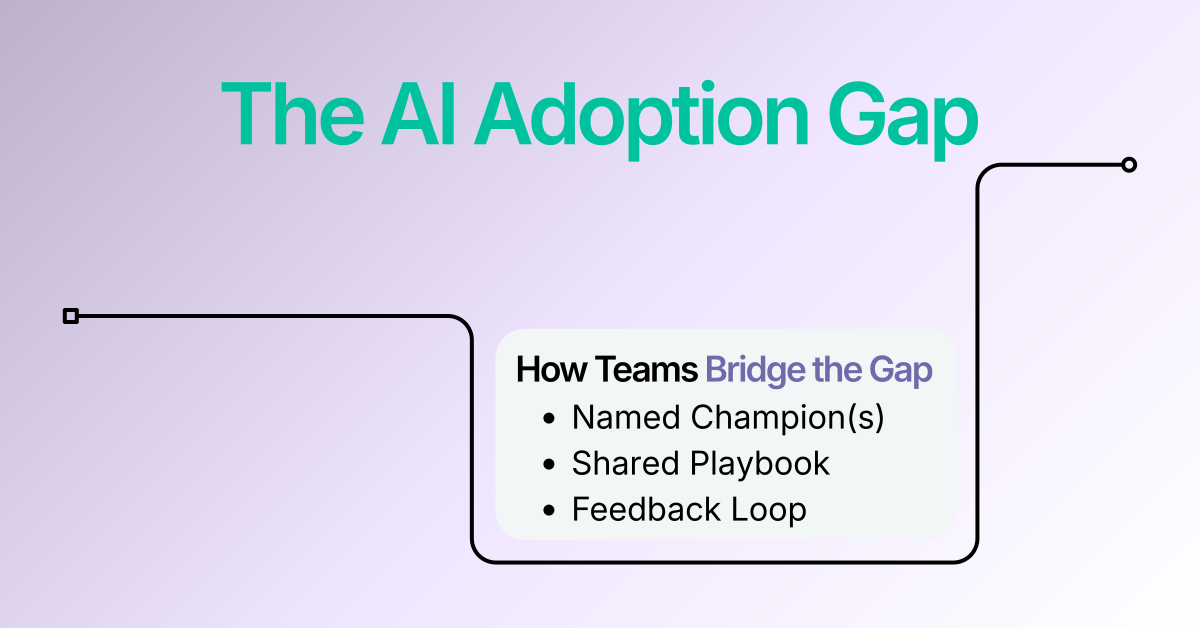
The teams getting real ROI from AI are building a different operating model around their software. Three levers separate them from everyone else:
1. A Named Champion
Successful teams choose one person whose job includes making AI work for the rest of the team. It’s not a full-time role in most cases, but it is a defined responsibility with dedicated time and a clear mandate.
2. A Shared Playbook
High performers document use cases, tested prompts, and role-specific standards. They’re creating a living library of what actually works, maintained by the champion and updated as the tools evolve.
3. A Feedback Loop
Winning teams build a mechanism for bad outputs to become learnings instead of write-offs. When a user gets a mediocre AI response, the champion diagnoses why, fixes it, and shares the fix. One bad experience becomes an improvement, not a reason to give up.
Without all three levers, you have adoption theater: the appearance of AI usage without the organizational infrastructure to make it consistent, scalable, or measurable.
AI Champions Are Internal Sales Engineers
Think about a Sales Engineer.
They don't carry quota. But they're often the reason deals close. Their job is to bridge the gap between what the product can do and what the customer actually needs. They translate raw capability into outcomes the rest of the team can act on.
Your AI champion is the SE for your internal operations. Same function, entirely new domain. A sales engineer bridges the technical gap for a successful sale; a champion bridges the gap for successful AI adoption.
4 Transformation Themes for Sales Teams Adopting AI
An AI champion brings 4 key benefits to your team’s implementations:
1. Make AI Visible
A champion shows what good AI use looks like in real work contexts. Peer influence creates adoption faster than any top-down mandate.
2. Avoid the “One Bad Experience” Trap
When a rep gets a bad output and starts to write the tool off, the champion helps them catch it, diagnose the failure, and fix it before cynicism spreads.
3. Build and Maintain the Playbook
A champion turns individual experiments into team-wide standards. This creates consistency where there once was chaos.
4. Keep the Team Current
In 2026, AI tech moves faster than anyone carrying a quota can track. The champion monitors what's new, tests what's relevant, and translates it into practical workflow changes.
AI adoption rarely happens in isolation. If you want your reps to actually use AI, dedicated sales training sessions are the missing link. Structured workshops are the exact environment needed to turn quiet, individual experimentation into a shared, repeatable team playbook.
The AI Sales Implementation Master Guide: Best Practices for the First 90 Days
The teams that break out of AI pilot purgatory move fast on three things in the first 90 days. The teams that don't make these moves are still stuck at the same stage a year later.
What gets measured gets managed. When AI adoption appears on the same dashboard as quota attainment, it signals to the team that this is a performance expectation—not an optional experiment.
Case Study: Championing AI at a $180M ARR B2B Business
At ChurnZero, a CSM named Sean Brookover wasn't trying to become an AI champion. He just used AI during a team training workshop to complete a success plan exercise in roughly 30 seconds.
The questions started immediately. His team wanted to know how he did it. One person showing their use case changed the adoption trajectory for his entire team.
That person already exists on your team. They're quietly experimenting with AI on their own. Helping a colleague get unstuck. Maybe even sharing results in Slack. They're already a champion, it just isn’t official yet. They could be a RevOps lead who spent three weeks building a prompt library their team actually uses. A sales enablement manager who turned one successful AI workflow into a team-wide standard before anyone asked them to. The important thing is that the right person champions the initiative, regardless of their role on the team.
The AI Implementation Questions to Ask Today
Look at your team right now.
Ask yourself: who's already experimenting? Who’s helping colleagues? Who’s curious about what these tools can actually do?
That person is your champion. Give them the mandate. Then track the results.
Get Started
At Chief, we’ve built our predictive revenue intelligence platform specifically for the teams that want to join the 5% and get real ROI. Chief gives your AI Champion the pipeline visibility and rep-level data they need to promote adoption and track success.
Learn more in our guide to closing rep performance gaps.