.svg)


TL;DR
- Roughly 80% of sales organizations miss their forecast by 25% or more, and the primary gap is action.
- Sales prediction software splits into three categories: CRM-native forecasting, AI revenue intelligence, and revenue execution.
- We reviewed five tools: Salesforce Agentforce, Clari, Gong, Aviso, and Chief.
- Users care most about price, vendor support, and time saved.
- The most-requested features were conversation intelligence and engagement tracking.
- Almost nobody addresses what happens after the prediction lands. That gap is where most missed forecasts actually come from.
The Problems Sales Prediction Software Solve
Sales prediction software analyzes deal and rep-level data (e.g., CRM fields, activity history, sometimes call and email data) to forecast which deals will close, when, and for how much.
Most teams already have some version of this. It could be a stage-weighted rollup in Salesforce, a dashboard from an intelligence platform, or a gut-check number a VP defends in the Monday pipeline review. The problem with these approaches is that they aren’t very accurate. 69% of sales ops and RevOps leaders agreed that “creating accurate sales forecasts is harder today than it was 3 years ago,” in a 2025 report from Gartner. When a number informs all of your business planning, you can’t afford to miss by that much.
Accuracy is important, but the underlying problem isn’t always the prediction; it's what happens next. Knowing a deal has started slipping is one thing, but it’s useless if you can’t do something to save the deal. The forecasting tool may do its job well, but the team has to act on what the tool predicts.
“Most sales teams ignore predictions because they’re packaged as additional manual work. It’s so easy for reps to get lost in the grind. They need a true system of action.
The next generation of prediction tools can automatically analyze the data, follow the right playbook, and bring completed tasks to the rep ready to approve.
-Bret Larsen, Founder & CEO of Chief
This guide compares the top sales prediction tools on the market, what users actually say about them, and—most importantly—how to tell what kind of tool you actually need before you request the demo.
What Sales Prediction Software Does (and Doesn't Do)
3 Kinds of Sales Prediction Software
Most comparisons treat this as one category. It isn't. There are three distinct tiers, and the tools inside each one are built to solve different problems.
Knowing which tier you're actually shopping in changes the whole evaluation. A team asking "which tool has the most accurate AI?" is usually asking the wrong question. Accuracy differences between the mature players in this category are smaller than most vendor pitches suggest. The bigger differences show up in what each tier does with the prediction once it exists.
Very few tools in this category address that gap directly. Fewer still are built around it. That's arguably the more important buying criterion than raw prediction accuracy, and it's the one most comparison guides skip entirely.
The Top 5 Sales Prediction Tools
1. Salesforce Agentforce (Einstein)

Best for: Salesforce-native teams who want baseline AI forecasting without adding a new tool.
What users praise: Agentforce is the most-discussed tool in user communities by a wide margin. Most are curious about what agentic AI inside a CRM can actually do.
Where they push back: It's also the most negatively reviewed of the tools we reviewed. The complaints cluster around hype outrunning substance, thin training and context tooling, and confusion over pricing. The single largest cluster of questions in our research was people asking, in one form or another, what Agentforce actually does day to day.
Signal layer: Native CRM AI, applied on top of standard stage-based forecasting.
2. Clari
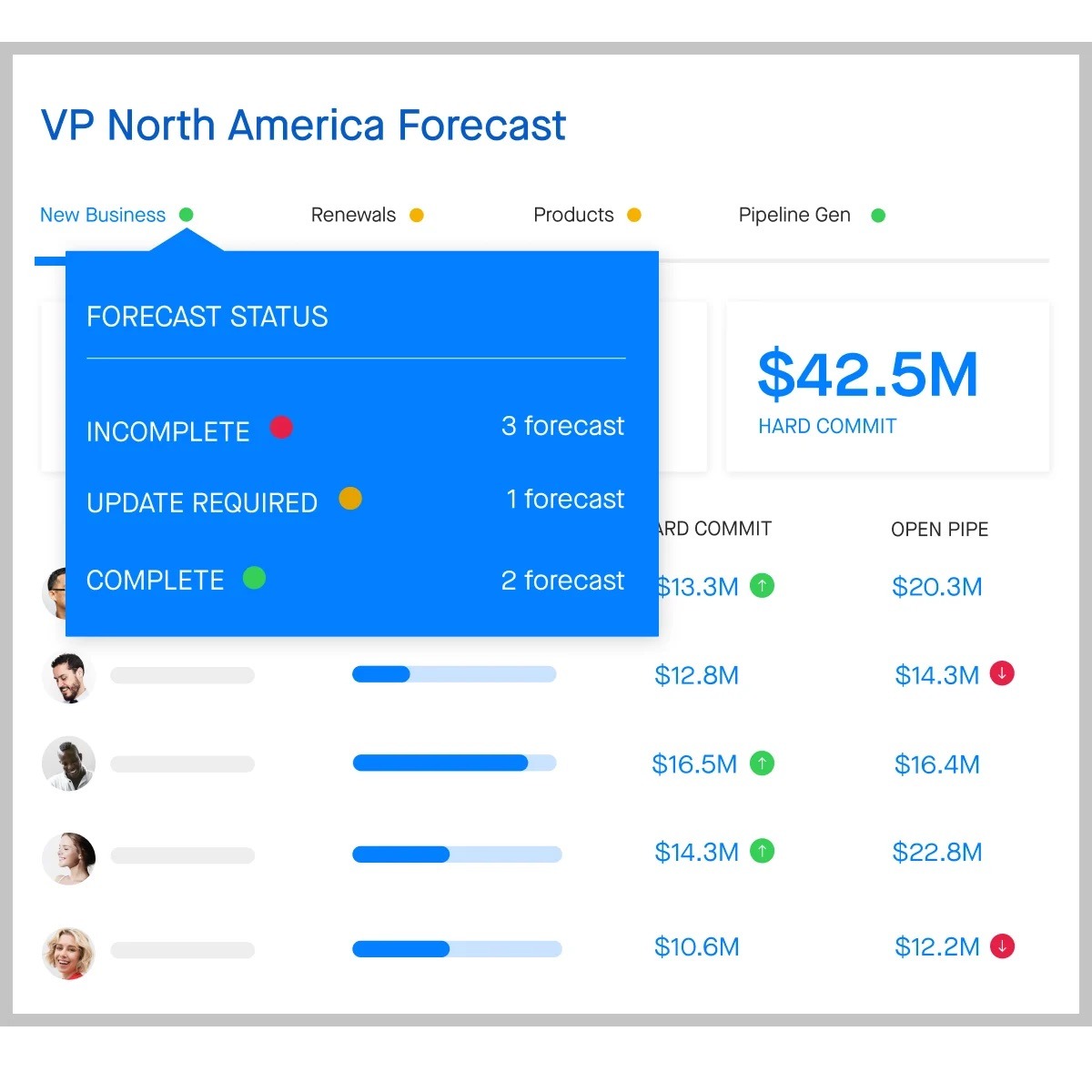
Best for: FP&A-optimizing organizations that need structured forecast rollups and governance across a large revenue org.
What users praise: Clari earns praise for reliability and a clean interface, as long as the underlying CRM data is in good shape.
Where they push back: Sentiment on Clari is the most split of any tool we reviewed. Users who trust their CRM data tend to love it. Users whose CRM data is a mess tend to blame the tool for reflecting that mess back at them. Data hygiene was the most common point of pushback, not the product itself.
Signal layer: Revenue intelligence, real-time pipeline visibility and forecast rollups.
3. Gong

Best for: Teams that want forecasts grounded in actual sales conversations, not just CRM fields.
What users praise: Gong has the strongest overall sentiment of any tool with a large enough sample to trust. The praise is driven by strong leadership buy-in and genuinely useful call analysis.
Where they push back: Cost was a common complaint, and we observed a recurring undercurrent of discomfort. Some reps read call-level AI scoring as managerial surveillance, or distrust the accuracy of the AI doing the scoring.
Signal layer: Conversation and revenue intelligence.
4. Aviso

Best for: Mid-market and enterprise teams that want AI-native modeling with deep scenario planning, combining machine-learned forecasts with human judgment.
What users praise: Aviso secured the highest sentiment score of any tool we reviewed. Our sample for Aviso was small, so treat this as directional rather than conclusive.
Where they push back: Users said enablement and training resources were thinner than Clari’s, and made direct comparisons between the two.
Signal layer: AI-native forecasting platform.
5. Chief

Best for: B2B SaaS teams between $10M and $100M ARR who need actionable predictions.
What it does: Chief connects to your CRM and reads deal-level behavioral signals like engagement patterns, response velocity, stakeholder activity, etc. When a deal's predicted outcome starts to shift, Chief recommends and helps execute the specific play to change it, not just a flag that something changed.
Where it fits: Chief sits on top of the revenue intelligence tier, not inside it. It isn't trying to out-predict Clari or out-analyze Gong's call data; it's built for the step that comes after the prediction.
Community sentiment: Chief doesn't yet have a large enough sample of independent user discussion to score fairly. We're not including a sentiment figure here for the same reason we didn't fabricate one for any other tool in this list.
What Users Actually Say About Sales Prediction Software
We analyzed over 5,100 sentences of user discussion from Reddit communities (r/SalesOperations, r/sales, r/salesforce, r/revops, r/AI_Sales, r/techsales, r/b2b_sales) and LinkedIn, scored for sentiment and coded for recurring themes. A few patterns held up across the dataset:
- Cost and support beat accuracy. Price and ROI concerns, as well as vendor support quality, came up far more often than forecast accuracy itself. Most users treat baseline predictive accuracy as assumed. The deciding factor is usually the relationship and the effort the tool saves, not whose model is technically better.
- Data hygiene is a dealbreaker, not a preference. Hygiene came up less often than cost or support, but almost always took the same shape: a tool "failed" not because the AI was bad, but because the CRM data feeding it was bad.
- Users think about prediction through activity capture, not forecasting math. Conversation intelligence and email/engagement tracking dominate feature discussions. Predictive AI scoring—the defining feature of the category—barely cracks the top five most-discussed features.
- Spreadsheets are still in the mix. Even among teams that already own a dedicated forecasting tool, manual spreadsheet tracking still comes up regularly. Old habits die hard, so adoption of a new tool doesn't automatically retire the workarounds.
- Agentic AI is creating more questions than answers. The single largest cluster of open questions in the entire dataset was users trying to understand what agentic AI forecasting tools—and Agentforce specifically—actually do in practice, beyond the pitch. Users are still learning what agents can really do in a forecasting context.
What Users Want Their Sales Prediction Software to Do
10 core features came up in our analysis. We ranked them by how often they came up in user discussion:
- Conversation and call intelligence: analysis and recommendations based on what was said in a call, and how.
- Email and engagement tracking: visibility into how prospects are actually responding, not just what's logged manually.
- Pipeline management and deal inspection: the connective tissue between a prediction and a deal review.
- Dashboards and reporting: expected as a baseline, rarely a differentiator on its own.
- AI/ML deal scoring and predictive forecasting: the category's namesake function, and yet only the fifth most-discussed capability
- Deal-risk alerts and warnings: notifications about deals that have gone dark or started slipping.
- Scenario planning: the ability to model different "what if" conditions and their outcomes.
- Spreadsheets: The status-quo solution for many teams.
- Forecast roll-up and submission: Reporting for more FP&A-oriented orgs.
- CRM auto-capture and activity logging: logging engagements without manual input for improved data and prediction quality.

Buyers in this category are shopping for visibility into what's actually happening on a deal more than they're shopping for a better prediction algorithm.
How Users Feel About the Top Tools
How to Choose the Right Tool
Before you sign up for a demo, ask four key questions:
- Do you just need a prediction, or do you need an actionable prediction? Most of this category answers the first question. Very few answer the second.
- Is your CRM data clean enough to run machine learning on? Any vendor promising a high accuracy figure should be able to tell you the optimal data-quality conditions for their tool
- What's your team size and sales motion? CRM-native tools tend to suit small, transactional teams. AI intelligence platforms tend to suit larger, more complex enterprise motions. Execution platforms tend to fit the growth-stage range in between — roughly 5 to 50 AEs.
- Where does the prediction actually go? Who gets notified when a deal shifts, what are they told to do about it, and who's responsible for doing it?
Common Questions
What is sales prediction software?
Sales prediction software analyzes CRM and activity data to forecast which deals are likely to close, when, and for how much. It ranges from simple stage-weighted rollups built into a CRM to AI-driven platforms that read behavioral signals across a deal.
What's the difference between sales prediction software and sales forecasting software?
In practice, they're close to synonyms. "Prediction" tends to signal a stronger AI/ML component — pattern recognition across historical deals — while "forecasting" is used more broadly, including manual and stage-weighted methods.
Is sales prediction software the same as demand forecasting software?
No. Sales prediction software forecasts deal-level revenue outcomes for a sales team. Demand forecasting software predicts customer demand for inventory, supply chain, and production planning. They solve different problems for different teams, even though search results often blend them.
Is Salesforce a sales prediction tool?
Salesforce's native forecasting, and its Agentforce AI layer, provide baseline sales prediction inside the CRM. It's a reasonable starting point for teams that want prediction without adding a new tool, though it lacks the deal-level behavioral signals dedicated platforms surface.
What's the best sales prediction software for a B2B company under $100M ARR?
It depends on what's missing today. If the CRM data is clean and the gap is visibility, an intelligence platform like Clari or Gong fits. If the gap is turning a prediction into a completed action, that's the problem Chief is built for.
Does sales prediction software work without clean CRM data?
Not well. Every tool in this category is only as good as the data feeding it. Data hygiene issues are one of the most common reasons users report disappointment with a prediction tool, regardless of vendor.
How is Chief different from Clari or Gong for sales prediction?
Clari and Gong are built to generate the most accurate and detailed prediction possible. Chief is built for what happens after — recommending the specific action a rep or manager should take when a deal's predicted outcome shifts.
How accurate is AI sales prediction software?
Accuracy claims vary widely across vendors and are usually conditional on clean CRM data. Ask any vendor promising a specific accuracy figure what data-quality standard that figure assumes — the number means little without that context.
Does sales prediction software integrate with my existing CRM?
Most dedicated prediction platforms integrate with Salesforce and HubSpot, the two most common CRMs among growth-stage B2B teams. Confirm integration depth and any custom-field limitations before buying.
Methodology & Limitations
Tool categorization is based on synthesis of public vendor positioning and third-party industry coverage. User sentiment is drawn from natural language processing (VADER sentiment scoring) applied to over 5,100 sentences of Reddit and LinkedIn discussion, coded for recurring themes around buying drivers and desired features.
The sample is self-selected; people who post about sales tools online aren't a random sample of all sales tool buyers. Sample sizes vary significantly by tool, and Aviso's sample in particular is too small to treat as conclusive. Sentiment scoring can also misread sarcasm and comparative statements ("Gong is better than Clari, which is a disaster" can score oddly). Treat these findings as directional signal from real user conversation, not a full scientific survey.