.svg)


Becc Holland lost the same deal twice.
Holland did everything right: she built trust, stayed top of mind, and moved the deal forward. She spent months building a relationship with a CRO at a high-value account. They left the company, and the deal died overnight. She built a relationship with the new CRO. That person left too. Hours of work evaporated twice, because the entire deal depended on one relationship.
Holland, now CEO of Flip the Script, tells that story as a lesson about single-threading. It's also a broader lesson about deal management: have the discipline to build sales processes that don't depend on any one thing going right.
Most deals don't die because a competitor won. 86% of B2B purchases stall at some point during the buying process. 40 to 60% end in no decision. The most common outcome of a qualified B2B sales process is a slow fade. No one sees that fade coming, even though it telegraphs itself for weeks.
This guide is about how to catch those stalling deals early and get them moving again.
Want a faster answer? The Deal Management Scorecard gives you a personalized read on your pipeline in under five minutes. It helps you see where your deals are most at risk, which failure patterns are showing up, and where to focus first.
What Is Deal Management?
Deal management is the ongoing process of tracking, evaluating, and intervening in active opportunities across the sales cycle. Pipeline management takes a portfolio view (how much is in each stage, what's the coverage ratio, will we hit the number). Deal management goes one level deeper: for each individual opportunity, what is actually happening, what is blocking it, and what specific action changes the outcome.
Deal management is a behavioral discipline. Consistent deal inspection surfaces what deals actually signal (activity patterns, stakeholder engagement, next step quality, time since last buyer-initiated contact). If you don’t manage deals consistently, you’ll lose opportunities that could have been saved with early intervention.
For managers, this problem has a scale dimension. A rep manages their own deals. A manager is responsible for 15 to 25+ active opportunities across an entire team. This means pattern recognition fails, rep narrative fills the information gap, and the deals that most need attention are often the ones most successfully described as “fine.”
Effective deal management answers three questions for every active opportunity:
- What is the actual state of this deal?
- What is specifically blocking it?
- What action changes the outcome?
Why Deals Stall
To manage a deal effectively, you need to understand the root causes of stalling. There are four stall patterns that show up repeatedly in B2B pipelines:
1. Single-Threaded Relationships
In this pattern, the rep only has one contact: a champion who's enthusiastic, responsive, and internally aligned. Then that champion goes on parental leave, gets pulled into a reorg, or goes to another company. The deal has no redundancy. One relationship going quiet equals one deal going quiet.
Seventy percent of B2B opportunities have only one contact logged in the CRM. But the average buying decision now involves thirteen people across two or more departments, and average buyer tenure has dropped to eighteen months. This means the person who started evaluating your product may not be there to finish the deal.
Single-threaded deals close at 5% on average, while deals with five-plus engaged stakeholders close at 30%. That’s a 6x difference. Won deals have twice as many buyer contacts as lost deals. There’s a clear winning pattern here, and it’s not even close. A passive approach to the buying committee exposes you to the same risk that caused Holland to lose two deals in a row.
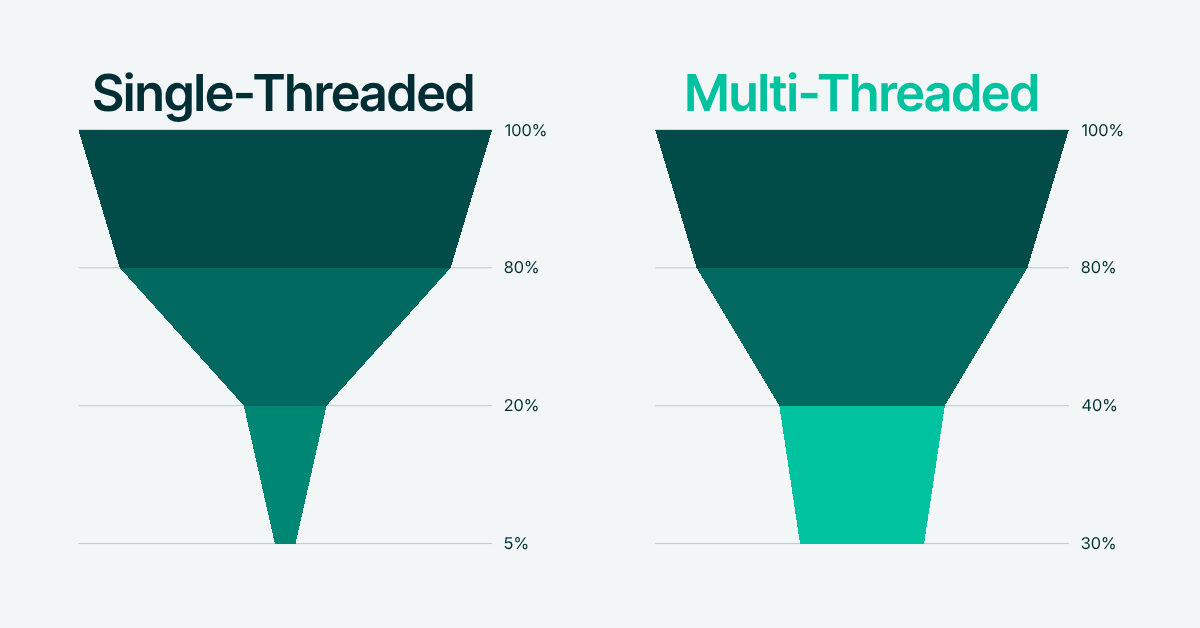
In a deal review, this shows up as a single-threaded deal with one contact in the CRM at Stage 3 or later, and no documented outreach to other stakeholders.
2. Unaddressed Buying Committee Objections
The champion is sold, but the rest of the committee isn't. The rep doesn't know it yet because the champion has been filtering the internal conversation.
This is the failure mode that underlies the "they're aligned internally" assumption. 79% of B2B purchases require CFO approval. Legal has a vendor consolidation policy. IT has a security requirement that nobody mentioned until the rep sent the order form. Finance is protecting the budget. The champion's endorsement is genuine. It's also insufficient.
The rep often stays in the champion's lane and lets them manage the internal process. The manager's job is to challenge that instinct: who specifically have we talked to in legal, IT, and finance? What do we know about their concerns? What hasn't been asked yet?
In a deal review, this shows up as a late-stage deal where the only documented stakeholder contact is the primary champion. Make sure every deal has engagement with procurement, legal, and the economic buyer as soon as possible.
3. No Next Step with Date and Owner Attached
"We'll circle back after the holidays" is not a next step. "Following up next week" is not a next step. A next step is a specific action, owned by a specific person (on either side of the deal), with a committed date.
Indecision causes deal losses around 61% of the time. A lack of owned, concrete next steps are a huge factor in that indecision. Deals that were never pushed to a specific next step die in No Decision because nobody forced the question.
In a deal review, this shows up as a next step field with no date, missing meetings, or a close date that has slipped multiple times with no change in activity level.
4. No Mutual Action Plan
The rep thinks the deal is in negotiation. The buyer thinks they're still evaluating. The rep believes the demo covered all technical requirements. The buyer's IT team is four weeks into a security review the rep has never heard of.
When there's no shared document defining what has to happen before a decision, both sides construct their own version of the deal's status. Those versions diverge. The divergence compounds. At the end of the quarter, the rep is surprised. The manager is surprised. The buyer was never confused; they were always on their own internal timeline.
70% of revenue leaders who adopt mutual action plans (MAPs) report win-rate improvements, with an average 13% lift. MAPs work because they force the implicit to become explicit before the end-of-quarter surprise.
In a deal review, this shows up as a rep who can describe the deal's status in detail but can't confirm whether the buyer has the same understanding of what the next milestone is. A missing MAP in late stages is a glaring red flag.
The Deal Management Process
A deal management process is a structured framework for consistently answering the three core questions (actual state, specific blocker, action that changes the outcome) for every deal in the pipeline.
1. Qualification Review
Before you can manage a deal, it needs to pass a genuine qualification review (i.e., a substantive assessment of whether the opportunity is real). Does it meet ICP criteria? Is there a confirmed problem and urgency? Is there available budget? Is there a decision timeline and a named decision-maker?
Top performers are 588% more likely to apply a structured qualification methodology (MEDDPICC, SPICED) than average performers. The best deal management process produces nothing if it's applied to unqualified opportunities. The manager's role here is to review qualification rigor, not accept rep self-certification.
2. Stakeholder Mapping
For every active deal, the team should be able to answer: Who is the economic buyer? Who is the champion? Who is the skeptic? Which functions are involved in the decision? Which stakeholders have we engaged, and which haven't we? Where are the unaddressed concerns sitting?
Mapping shouldn't happen once at deal entry. Stakeholder landscapes change. Champions leave. New evaluators get added. The map is a living document, reviewed at every deal review, updated as new information surfaces. This is the structural defense against the single point of failure that cost Holland months of work.
3. Risk Identification
For each deal, there is a specific risk most likely to kill it. Name it: single-threaded relationship, budget not confirmed, security review not started, a competitor in late-stage evaluation, a champion without executive sponsorship. The answer should never be "we don’t know." Make an educated guess if you have to.
Identifying the risk is the prerequisite for doing something about it. Managers who ask "what's the primary risk on this deal?" in pipeline review get a different conversation than managers who ask "where does this deal stand?" One produces actionable information; the other produces narrative.
4. Intervention Planning
Once you’ve pinpointed the risk, your intervention should match it. A single-threaded Stage 3 deal needs a multi-threading play, not another follow-up call with the existing contact. A deal with an unaddressed IT concern needs an IT outreach now, not after the champion confirms they're ready to decide. A deal with no confirmed budget needs a financial conversation, not a product demo.
Generic deal advice like “stay in touch,” “keep momentum,” and “add value” deal management theater. Optimizing for activity alone isn’t enough. Deal management is all about actions that drive outcomes.
5. Cadence and Metrics
How often you review deals should match your revenue motion, including your sales cycle. As a rule of thumb, review late-stage deals at least weekly, bi-weekly for mid-stage, and monthly for early-stage.
The metrics that tell you whether the process is working operate at two levels. At the deal level, they flag individual opportunities that need attention:
At the portfolio level, the same metrics surface systemic problems: if every Stage 3 deal is running long, you have a process issue. This where the intervention shifts from coaching individual reps to fixing a flow.
Deal Inspection and Review
The deal management process only produces results if it's applied consistently. This means it needs a home in the weekly cadence. That home is the deal review.
Most pipeline reviews are status updates in disguise. The rep walks through each deal; the manager asks a few questions; everyone leaves feeling like progress happened. But all they did was deliver a narrative.
A deal review that works is built around inspection, not reporting. Here's what the difference looks like in practice:
Prepare before the meeting. Before any conversation with a rep, the manager has reviewed the deal data: activity patterns, contact coverage, days since last buyer-initiated engagement, next step quality, and forecast category. The manager arrives with a point of view. The meeting is to pressure-test the manager's read against the rep's context, not to receive information for the first time.
Ask questions that require specificity. "Walk me through this deal" produces a narrative. "Your last buyer-side interaction was 23 days ago. What happened after that call?" produces information. "You have one contact at Stage 4. Who else is involved in their decision?" "The close date is in 12 days and there's no signed order form. What's the specific path?" Pay attention to that pattern: observe, then ask. These questions can only be asked by a manager who has done their homework.
Leave with a named risk and a specific action. The output of a deal review is an action plan, not a status. What is the primary risk? What specific action addresses it? Who owns it? By when? Deals that leave a review without a named next action have been observed, not reviewed.
Define what "at-risk" means before the meeting. What triggers escalation? What constitutes a zombie deal? An opportunity with no recent buyer-side activity that's still sitting in the forecast? You need to apply consistent definitions across all deals and all reps. Making judgement calls in the moment leads to unpredictable outcomes.
CRMs are passive record-keeping systems. They capture the data reps enter; they don't surface the signals in the deals. Deal intelligence platforms sit on top of the CRM and pull in behavioral data from email activity, calendar, and stakeholder engagement to flag deals that have gone quiet.
Where to Start
If scenarios like Holland’s single-thread fiasco felt familiar, getting started doesn’t have to be complicated.
Before your next pipeline review, run every active deal through five questions:
- When was the last buyer-initiated interaction?
- How many contacts are active at the buying company?
- Is there a specific next step with a date and an owner?
- What is the primary risk?
- What intervention addresses it?
The answers will tell you which deals are progressing and which are already signaling a stall. And they'll tell you before the quarter ends—the only time an intervention matters.
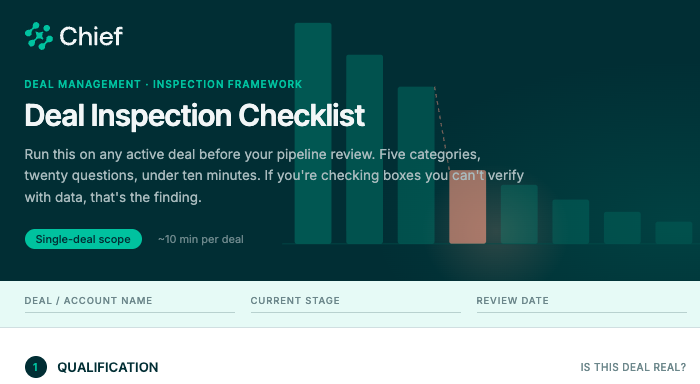
This Deal Inspection Checklist structures these questions into a simple framework you can run on any deal in under ten minutes. Use it to guide your next deal review.
Download the Deal Inspection Checklist →
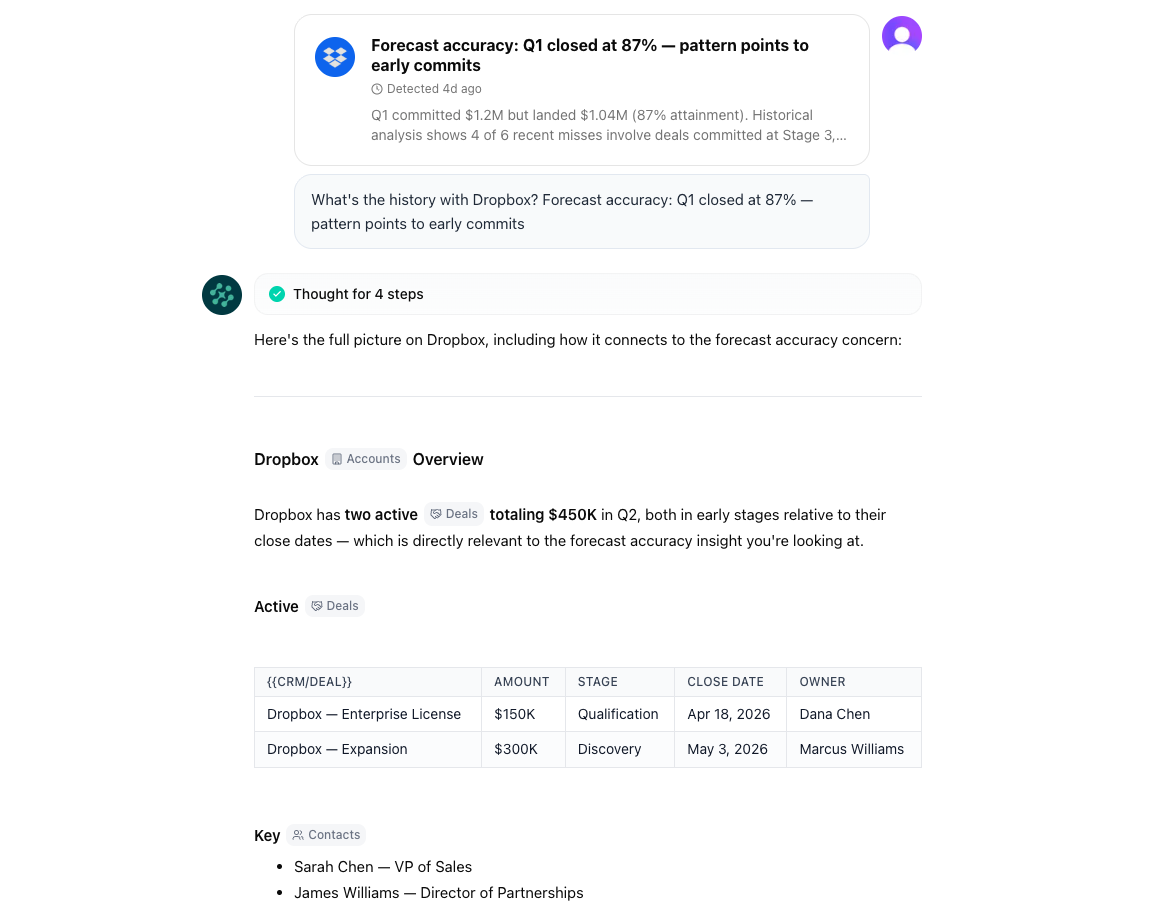
Chief helps sales and revenue teams identify stalled deals and intervene sooner. Chief delivers deal-level intelligence, provides next steps, and helps your team execute faster. Try Chief free today.