.svg)


I recently talked to two revenue leaders who echoed the same problem: their pipeline didn’t reflect reality.
One of them said “the stages are sometimes subjective.” The other characterized their pipeline forecast as a “wishcast.” Some deals progressed without meeting any real criteria. Others stalled because of missing data.
The throughline was a pipeline with no way of telling the difference between a real deal and a dead one. Their pipelines weren’t built to mirror how their ideal customers actually buy. They tracked rep activity and sentiment, but not buyer activity or sentiment—where pipeline risk actually lives.
In this article, we’ll explore how leading revenue teams are building their pipeline to reflect reality and mitigate risk.
Buyer Behavior Is Changing
The traditional pipeline moved individual leads through a linear funnel all the way to close. That structure doesn’t work anymore. In 2026, buyers coordinate in groups, do their own AI-assisted research (Forrester found that 89% of business buyers use Gen AI way back in 2024), and create a shortlist before they ever touch your funnel. If CRM setup and metrics don’t reflect this reality, you won’t have a trustworthy pipeline—which kills your ability to predict revenue. This means you need to restructure your systems to match how modern buyers actually operate.
What Most Teams Get Wrong about the Sales Pipeline
92% of the pipeline building discussions I found in my research treated the pipeline as little more than a sales process tracker. Deals move through stages when something happens. Stages get named after seller activities. The CRM becomes a record of what the rep did, instead of a clear picture of where the deal actually stands.
A buyer-oriented approach is much more effective. Think of your pipeline as a risk mitigation system. Every stage is a risk gate. Moving a deal through that gate means two things: 1) you've reduced the probability it falls apart, and 2) you can prove the qualifying event happened.
If you can't prove the event happened, the deal doesn't belong in that stage. In practice, that means you can't say a deal is in "Proposal" unless you have an email showing the proposal was received. You can't say it's in "Contracting" unless there's an email with the contract attached. It belongs wherever the last verifiable thing occurred.
Designing the pipeline as a series of buyer behavior risk gates makes it reflect reality, i.e., trustworthy. And a trustworthy pipeline is the only kind worth building.
3 Ways to Build a Pipeline that Reflects Reality
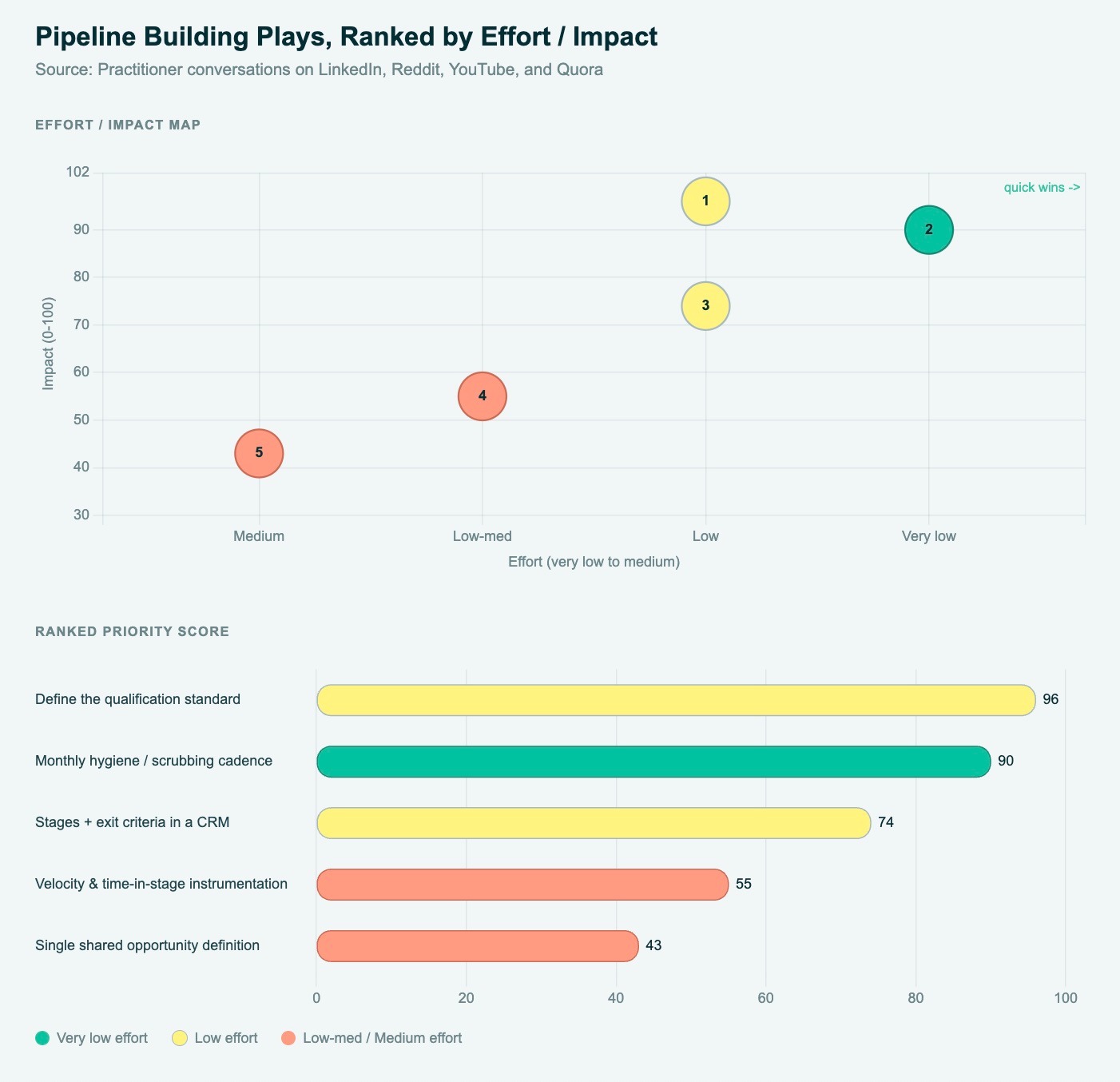
I know. Rebuilding the pipeline sounds like a tall order. To make it a little easier, I’ve ranked structural pipeline plays by leverage (impact vs. effort, based on my own experience and the discussions in my research). These moves cost almost nothing, other than discipline. They also happen to be the ones most teams either skip entirely or deprioritize in favor of tooling and complex processes.
1. Refining the ICP: "IICP" & Committee Mapping
Historically, defining an Ideal Customer Profile (ICP) meant creating a static list of target accounts based solely on firmographics like company size, industry, and revenue. Today, that approach is far too broad and wastes valuable sales capital.
- Move to the In-Market Ideal Customer Profile (IICP): Because only a small fraction of your total addressable market is ready to buy at any given time, your ICP needs to evolve into an IICP. This means layering intent data, behavioral signals, and third-party web traffic over your standard firmographic data to identify which accounts are actively demonstrating purchase propensity today.
- The Three-Layered Profile: Defining the target can no longer stop at the company level. A modern profiling system requires three distinct layers: the company-level fit (the ICP), the individual-level fit (the specific Buyer Personas), and the structural "Buying Committee Map" (identifying all the cross-departmental stakeholders required to close the deal).
2. Defining Stages and Exit Criteria: Buyer Consensus Gates
In a lead-centric pipeline, stages are often defined by seller actions (e.g., "Demo Given" or "Proposal Sent") or subjective rep feelings (e.g., "75% likely to close"). This creates massive pipeline bloat and forecasting inaccuracies.
- Focus on Exit Criteria, Not Stage Names: The modern pipeline should be kept lean, ideally limited to 5 to 7 stages, where progression is dictated by 2 to 4 strict, verifiable exit criteria per stage. The criteria, not the stage name, are what actually advance a deal.
- Observable and Auditable Actions: Stage definitions must be entirely objective. For example, "Discovery Complete" is an invalid stage definition. A modern exit criterion would instead be: "Discovery call completed with the economic buyer, specific BANT/MEDDPICC criteria documented, and the full buying group identified".
- Enforcing Multi-threading: Early-stage exit criteria should include strict requirements for mapping the buying committee and building relationships with two or more contacts. This risk gate prevents having pricing discussions or moving deals forward prematurely.
3. Regular Pipeline Audits: Velocity & Momentum
The traditional quarterly pipeline review is a static exercise that usually focuses on total "paper value" and volume. In a risk-based model, audits must aggressively weed out deals lacking buying committee momentum.
- Weekly Velocity Reviews: Stagnant deals are the silent killer of predictable revenue. By the time a quarterly review happens, a deal that has sat inactive in a discovery stage for 60 days is already dead. Move your audits to a weekly cadence to catch "deal rot" and track daily pipeline velocity.
- Conversation Audits: A true pipeline audit goes beyond looking at stages; it verifies whether actual engagement is happening. For instance, an audit might reveal dozens of opportunities sitting in a late stage with high dollar values, but upon inspection, find that the majority haven't had a single two-way conversation in over three weeks. Without verifiable buyer activity, it isn't a pipeline; it's a graveyard with optimistic labels.
- Momentum Metrics: Static pipeline value tells leadership what theoretically exists. Momentum metrics tell you whether the buying group is actually moving toward a decision. Your audits should heavily scrutinize silent days and penalize deals where only a single champion is communicating.
The Bottom Line: A Buyer-Centric Approach De-Risks Your Pipeline
Your pipeline isn't just a process tracker. It's a risk mitigation system. Every stage should represent at least one verifiable buyer-focused event that reduces the probability of a deal falling apart. And the proof should live in the CRM, not in a rep's memory.
Start here: audit one stage this week. Pick "Proposal," for example. Pull every deal sitting in it and confirm that a proposal actually exists. What you find will tell you more about your pipeline health than any dashboard.
If you're ready to use software to manage your pipeline at scale, read our guide to choosing the best pipeline management tools for your team.