.svg)


Every revenue leader I know has a shelf full of SOPs.
Call documentation requirements. Stage-progression criteria. Forecast update cadences. They have thorough playbooks for all of these processes. And they’re almost certainly ignored.
The uncomfortable truth is that you can’t SOP your way to predictable revenue. There are major constraints on your capacity to enforce SOPs. And until you solve that, you’re stuck in the Unpredictability Loop.
The Unpredictability Loop
This is what happens in the Unpredictability Loop:
- Low confidence in forecast → Leadership doesn’t trust the number.
- More internal inspection → Managers spend more time in deal reviews, scrubbing data, second-guessing reps.
- More admin burden → Reps spend more time documenting, updating, justifying—less time selling.
- Less selling time → Pipeline quality suffers. Deals slip.
- More volatility → Forecast confidence drops again.
Rinse. Repeat. Miss.

The data backs this up:
- Low Forecast Accuracy: Only 7% of sales organizations hit ≥$90% forecast accuracy, with median accuracy stuck around 70–79%.
- Increasing Difficulty in Forecasting: 69% of sales ops leaders say forecasting is harder than it was three years ago.
- Time Spent on Non-Selling Tasks: Reps spend 60%+ of their time on non-selling tasks.
- Inaccurate Data: Organizations believe roughly a third of their customer and prospect data is inaccurate.
- Low Confidence in Data Quality: Only 51% are confident their CRM data is clean enough for insights.
You can write all the workflows you want. But the data is inaccurate and reps are drowning in admin, so your process is running on a cracked foundation. If you have 10 reps making $150k OTE, you are paying $900k a year for people to not sell. Guardrails reclaim that time.
Why SOPs Aren’t Enough
Let’s be clear: I’m not anti-SOP. Clear standards matter. But this is why SOPs alone don’t produce predictable outcomes.
1. Enforcement assumes unlimited manager capacity.
Your frontline managers are your enforcement mechanism. But managers spend less than 10% of their time coaching. The rest goes to meetings, email, reporting, and firefighting. If your SOP depends on a manager catching every deviation, you’ve built a system that works only when you have infinite management bandwidth.
2. Compliance becomes theater.
I’ve seen this pattern repeatedly: 100% of deals documented as “multi-threaded” in the CRM, but only 4 of 13 actually had more than one contact engaged in the buying process. The checkbox got checked. The behavior didn’t change. When enforcement is manual and intermittent, reps learn to game the system rather than follow it.
3. SOPs are static. Deals are dynamic.
A standard operating procedure is a snapshot. It tells you what should happen. But deals don’t follow scripts. A champion goes dark. A competitor enters late. Budget gets reallocated. By the time a manager reviews the deal, the moment to intervene has passed. SOPs tell you what to do. They don’t tell you when something is going wrong.
Think Like a Manufacturer
In manufacturing, the best factories don’t rely on vigilance. They engineer systems that prevent defects from happening in the first place. Every process follows a predictable chain:
Trigger → Analysis → Decision → Action → Outcome.
A sensor detects temperature variance (trigger). The system evaluates whether it’s within tolerance (analysis). It determines the appropriate response (decision). It adjusts the equipment or alerts an operator (action). Output stays consistent (outcome).
Sales should work the same way.
When a deal stalls in a stage for 14 days past the historical average—that’s a trigger. The question is: do you have a system that detects it automatically, evaluates the risk, recommends an action, and tracks the result? Or do you rely on a manager catching it in a pipeline review… if they have time?
Most revenue orgs are still running on the vigilance model. They have documented processes but depend entirely on humans to notice deviations and enforce standards. That doesn’t work at scale.
Most revenue orgs are still running on the vigilance model. They have documented processes but depend entirely on humans to notice deviations and enforce standards. That doesn’t scale.
What Guardrails Are (and Aren’t)
There’s a concept in manufacturing called poka-yoke, or mistake-proofing. The goal is to design processes that either prevent errors from occurring or detect them immediately when they do.
A guardrail isn’t a rule that requires vigilance to enforce. It’s a design change that makes the wrong action difficult or impossible—and the right action easy or automatic.
Think of it this way:
Guardrails shift the process from “trust and verify” to “detect and correct.”
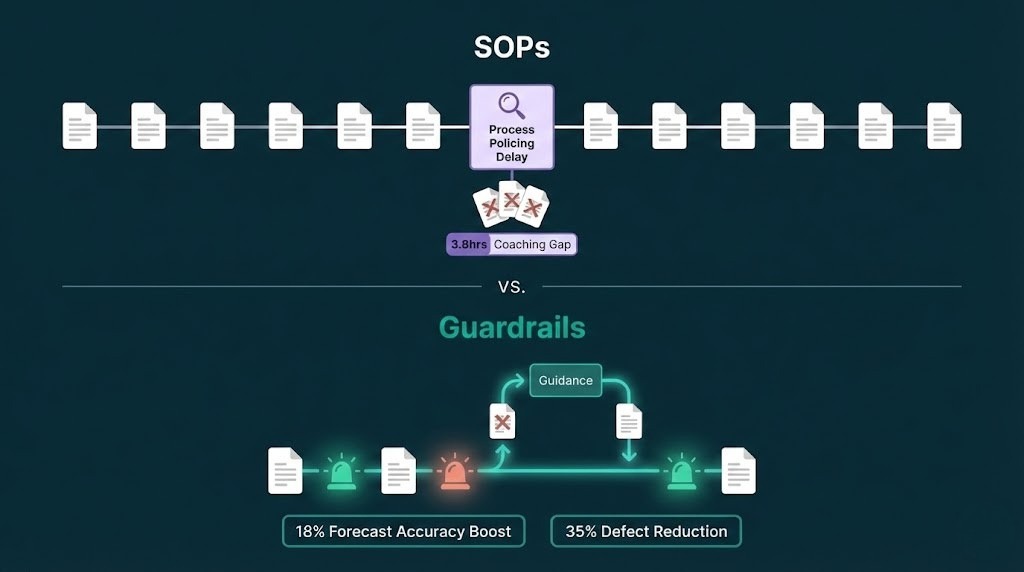
How Guardrails Change the Game
When you build guardrails into your revenue system, three things happen:
1. You see forecast drift earlier.
Traditional forecasting catches risk at the end of the month or quarter—when it’s too late to fix. Guardrails surface signals like stalled engagement, missed velocity benchmarks, and close-date slippage while there’s still time to rescue the deal.
2. CRM hygiene improves—without nagging.
The problem with CRM hygiene isn’t that reps are lazy. It’s that updating the system feels disconnected from selling. Guardrails embed updates into the workflow, prompting action at the moment it matters. And hygiene becomes a byproduct of doing the job, not extra work.
3. Coaching becomes targeted, not reactive.
Instead of reviewing every deal looking for problems, managers get a prioritized list of interventions that actually need their attention. Coaching time goes to high-impact situations, not administrative oversight.
A 2-Week Sales Guardrail Sprint
If you want to start building guardrails into your revenue system, here’s a practical framework you can run in two weeks.
Week 1: Map Your Triggers
Start by identifying the signals that predict risk in your business. Not theoretical risks—actual patterns from your historical data.
Questions to ask:
- What does “stalled” look like? How many days in a stage before win probability drops significantly?
- What engagement patterns predict slippage? No activity? Single-threaded? Missing decision-maker?
- Where do deals typically die? What stage? What quarter of the quarter?
- What behaviors correlate with deals that close vs. deals that don’t?
Document the top 10 triggers that matter most for your pipeline. These become your detection priorities.
Week 2: Define the Loop
For each trigger, define the complete Trigger → Analysis → Action → Outcome loop:
- Trigger: What signal indicates risk? (e.g., “Deal in Stage 3 for 14+ days with no logged activity”)
- Analysis: What additional context is needed? (e.g., “Is the deal single-threaded? Has the champion engaged in the last 7 days?”)
- Action: What intervention is prescribed? (e.g., “Alert rep and manager. Create task for re-engagement outreach.”)
- Outcome: How do you measure if the intervention worked? (e.g., “Deal progresses within 7 days OR is marked as lost/pushed.”)
The key is closing the loop. A guardrail without outcome tracking is just another dashboard that nobody watches.
Top 10 Triggers to Guardrail
Based on what we see across revenue teams, here are the highest-value triggers to start with:
- Stale deals: No activity logged in X days (calibrate to your average cycle)
- Stuck in stage: Deal exceeds historical stage duration by 50%+
- Close date drift: Close date pushed more than twice without stage change
- Single-threaded: Enterprise deal with only one contact engaged
- Missing decision-maker: No contact with “Economic Buyer” role in late stages
- Meeting without follow-up: Call logged with no next-step task created
- Forecast to commit without proof points: Rep commits deal lacking validation (e.g., technical win, business case)
- Late-stage velocity drop: Deal slowing down in final stages vs. early momentum
- Champion disengagement: Primary contact stops responding or attending meetings
- Competitive entry: Competitor mentioned in late-stage deal notes
You don’t need to automate all ten immediately. Start with the three that cause the most forecast damage in your business.
The AI Autonomy Ladder
Here’s where this gets interesting.
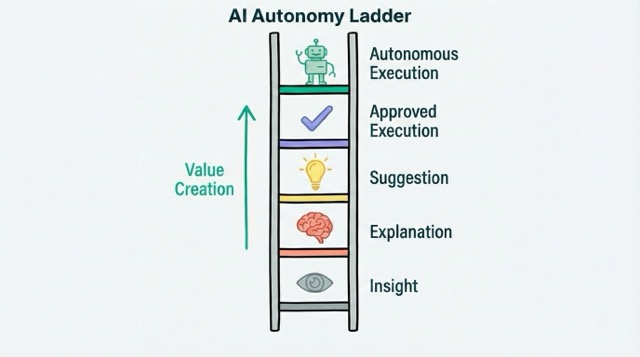
Right now, most guardrails require human-in-the-loop execution. The system detects risk, but a person decides what to do. That’s appropriate; you need to build trust in the detection logic before you automate the response.
But the steps to are clear:
Most teams are stuck at Level 1. The goal isn’t to jump to Level 4 overnight. It’s to build the detection layer (Level 2) and the recommendation layer (Level 3) so that when you’re ready for autonomy, you have the track record to trust it.
This is how AI will transform revenue operations—not by replacing human judgment, but by expanding its capacity.
The Bottom Line
Predictable revenue doesn’t come from hero managers catching problems. It comes from systems that detect risk early, prescribe action consistently, and track outcomes rigorously.
SOPs document what should happen. Guardrails make it happen.
Your best managers shouldn’t be spending their time auditing CRM hygiene and chasing down stale deals. They should be coaching reps on the conversations that win. Guardrails give them the time by covering the detection and prioritization.
The Challenge
How much of your current process is actually enforced, and how much is compliance theater?
Go audit it. Pick your five most critical SOPs. Then look at the actual data. Is the team following them? Are the behaviors changing? Or are they checking boxes while the problems continue?
If there’s a gap between your documented process and your actual execution, guardrails are how you close it.
To learn more, read our guide to improving sales processes.