.svg)


Updated February 13, 2026
AI is still fundamentally transforming what's possible. Last week, we used Claude Code to generate 120 SEO-optimized blog articles in four days.
Don’t get fooled, though. AI doesn't make bad teams good. It makes good teams 10x faster. What’s the difference between a bad team and a 10x team? Context architecture.
The Biggest Mistake in AI Sales Strategy
At Chief, we’ve learned that the same principle that makes AI revenue intelligence work is the same principle that makes AI everything work: You can't predict what you don't understand.
Revenue intelligence platforms haven’t been working because they try to analyze pipeline data without understanding the context of how your business actually works:
- What's a normal sales cycle for you?
- What does healthy deal velocity look like in your market?
- Which behaviors predict slippage in your pipeline?
Without that context, you get generic intelligence that doesn't match reality, which isn’t useful.
What Is Context Architecture Anyway?
Context Architecture is a systems-based approach to documenting business strategy as a “Source of Truth” that AI can use to make accurate, non-generic decisions.
Before we generated a single article in our content sprint, we spent weeks building comprehensive context documents:
- Complete content strategy with clear objectives and success metrics
- Brand voice and messaging guidelines
- Deep target customer pain point analysis
- 5 content pillars with precise positioning against competitors
- Detailed briefs for each content category mapped to buyer journey stages
We put all of that into a Github repository (the memory).
Then we pointed Claude Code (plus Sonnet 4.5 for language) at the repository and let it execute.
The AI didn't replace our content strategy. It amplified it. Without the context architecture, it couldn’t do that.
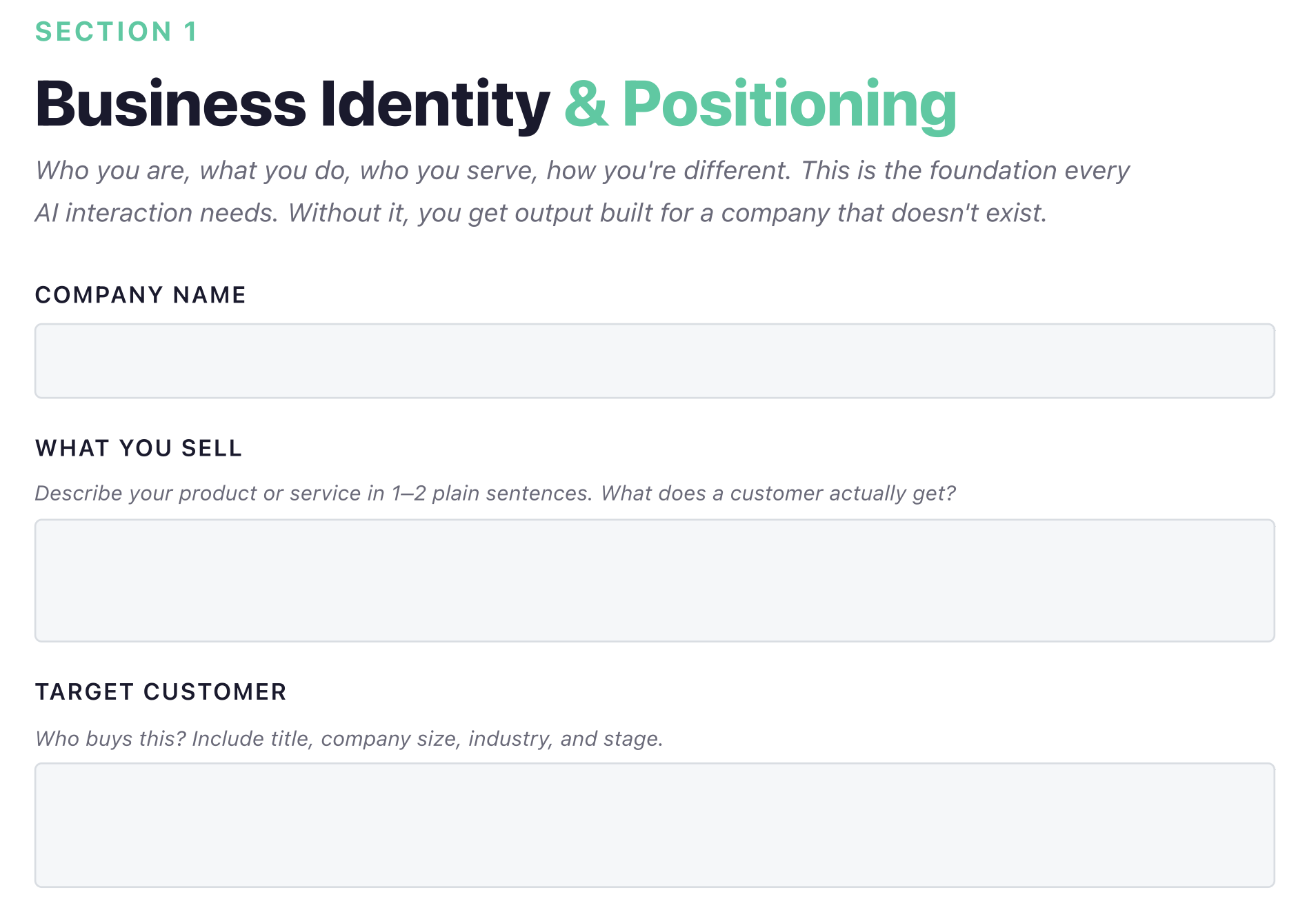
Steal My Context Library Template
Don't build from scratch. Get the exact framework I use to organize my workflows.
DownloadThe Big Shift in Revenue Intelligence: Proactive Insights
Manual processes force you to be reactive. Context-powered AI allows you to be proactive.
Think about how sales forecasting traditionally works:
- Deals sit in the pipeline
- A manager manually reviews them in a weekly forecast call
- Problems get identified (if you're lucky)
- By the time you spot the risk, it's often too late to fix it
This is the 0-to-1 playbook. Manual inspection. Periodic check-ins. Human-limited pattern recognition.
It works, but it doesn't scale. When your sales motion grows, manual forecasting only finds risk after it's too late to fix it.
Now look at how Chief works:
- AI continuously monitors every deal in your pipeline (not just the top 10).
- Behavioral pattern recognition flags deviation in real-time (not in next week's meeting).
- Insights surface with clear recommended actions (not just "this looks bad").
- You intervene early while there's still time to rescue the revenue.
The difference isn't just speed. It's finding problems before they become unfixable.
Building Your Context Architecture
I might sound like a heavy lift, but building your own context architecture is doable. Here's how to start:
1. Document your strategy relentlessly.
Don't keep it in your head. Get it into structured documents that AI can consume. Product strategy, brand guidelines, user research, competitive positioning, customer pain points, success metrics—all of it.
2. Define what healthy looks like for your business.
Generic models are useless. What does a healthy sales cycle look like for you? What's your target close rate? What behavior patterns predict success in your deals? Document the patterns so AI can recognize deviations.
3. Create reusable frameworks.
Instead of making similar decisions over and over, create frameworks that make those decisions automatic and repeatable. What's our process for evaluating new features? What's our content approval workflow? How do we prioritize which risks to address first? Document it once, reference it forever.
4. Build repositories.
Stop thinking about individual tasks. Start thinking about knowledge systems. Every project should add to your context repository, not just ship a deliverable.
5. Use AI to amplify
You still need humans for strategy, judgment, and taste. With context architecture, AI handles execution, monitoring, research, and iteration. Your role is to provide direction and quality control.
What We're Building
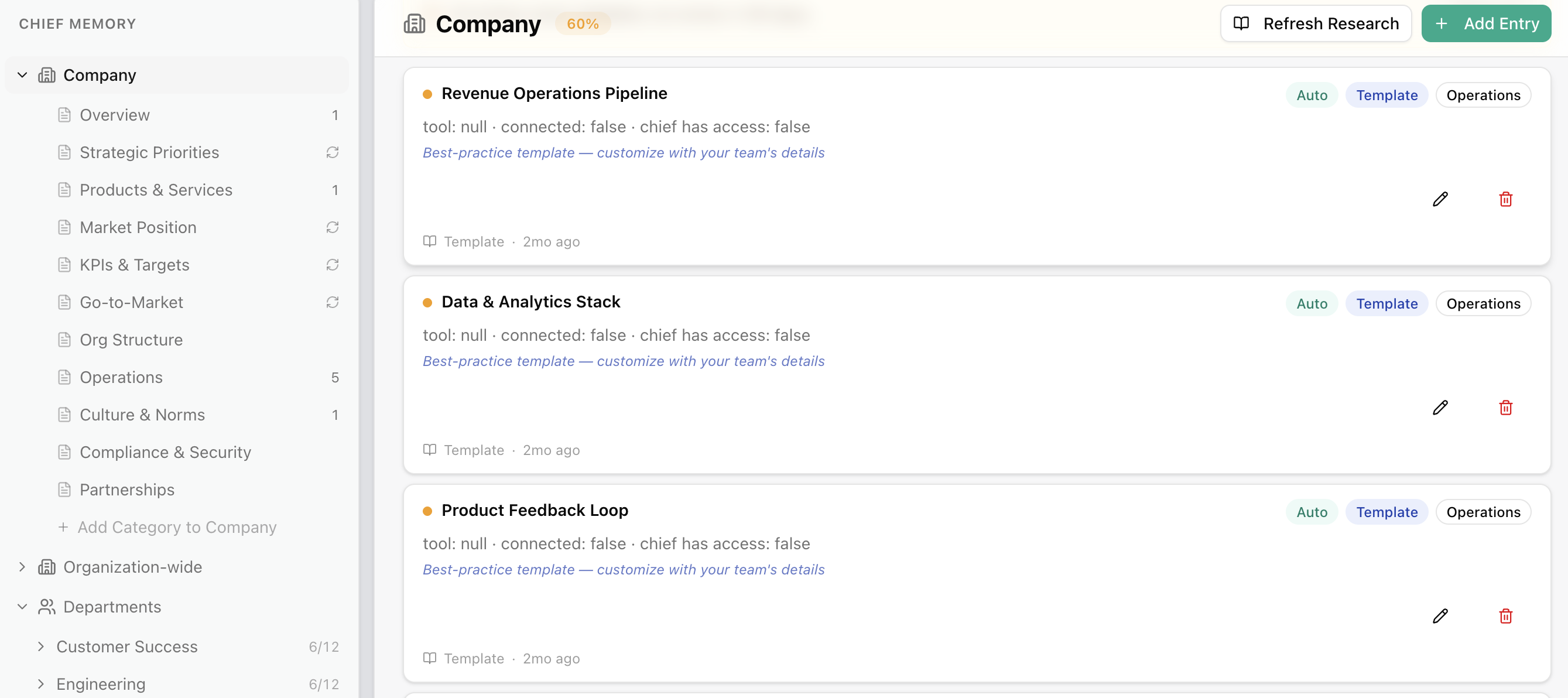
We're building context architecture into revenue intelligence with Chief's Memory. Before the AI can predict which deals are at risk, it needs to understand…
- Your company: vision, metrics, revenue model, go-to-market motion
- Your teams: org structure, territories, quota distribution
- Your data patterns: what healthy pipeline velocity looks like for you
- Your sales motion: stage definitions, typical deal cycles, win/loss patterns
Without that context, AI just gives you generic alerts that don't match your reality.
With Memory, your AI performance agents understand…
- Your company's go-to-market motion and success patterns
- Your typical deal cycles and what healthy velocity looks like
- Your team structure and territory coverage
- Your pipeline history and which behaviors predict slippage
Then they continuously monitor every deal, flag deviations from healthy patterns, and surface risks before they cost you revenue.
The Bottom Line
The future isn't just faster execution. It's faster execution with better judgment. And context architecture is how you get there.
So ask yourself:
- How much of your company's knowledge exists only in people's heads?
- How many decisions get remade every week because the context from last time is lost?
- How much time does your team spend searching for information they already found once before?
- Are you finding risks and opportunities early enough to actually do something about them?
That's the opportunity. Build the context. Amplify it with AI. Win.
To learn more, see our guide to sales forecasting.