.svg)

Sales Performance Coaching: How to Improve Rep Performance

Bret Larsen
minute read
Your mid-tier rep Sarah is stuck at 75% of quota. She's been there for three quarters straight.
You know you need to coach her. But coach her on what? Make more calls? Ask better questions? Be more persistent? Close harder?
You've tried generic coaching: "Be more consultative." "Create more urgency." "Build better relationships." Two weeks later, she's still at 75%. Nothing changed.
The problem? You're coaching for activity (make more calls) instead of performance outcomes (close more deals, faster).
Why Generic Coaching Keeps Reps Stuck at 75% of Quota
Most sales managers struggle to improve rep performance because they...
- Don't know what's broken: "Sarah's at 75% quota, but I don't know which skill is the issue"
- Coach generic activities: "Make 50 calls this week" (activity theater, not performance improvement)
- Have no performance baseline: Can't measure if coaching actually improved metrics
- Disconnect coaching from outcomes: Focus on inputs (calls, emails) not outputs (pipeline, revenue)
- Can't sustain gains: Rep improves for two weeks, then regresses back to baseline
The result: Mid-tier reps stay stuck. Performance doesn't improve. Your team misses quota. And you burn hours in 1:1s that produce no measurable results.
Companies with formal coaching processes see 91% quota attainment compared to 85% for those without—but only if the coaching is performance-based.
In this guide, we'll explore performance coaching, a 4-step framework that ties coaching directly to performance metrics. The goal here is to help you improve rep performance measurably and sustainably.
What Is Sales Performance Coaching?
Sales performance coaching is coaching that...
- Focuses on performance metrics (pipeline coverage, stage conversion rates, deal velocity, win rate, quota attainment)
- Ties coaching to measurable outcomes (not just activities completed)
- Uses performance data to diagnose gaps (not gut feel or intuition)
- Tracks performance improvement (baseline → target → actual results)
The Critical Difference
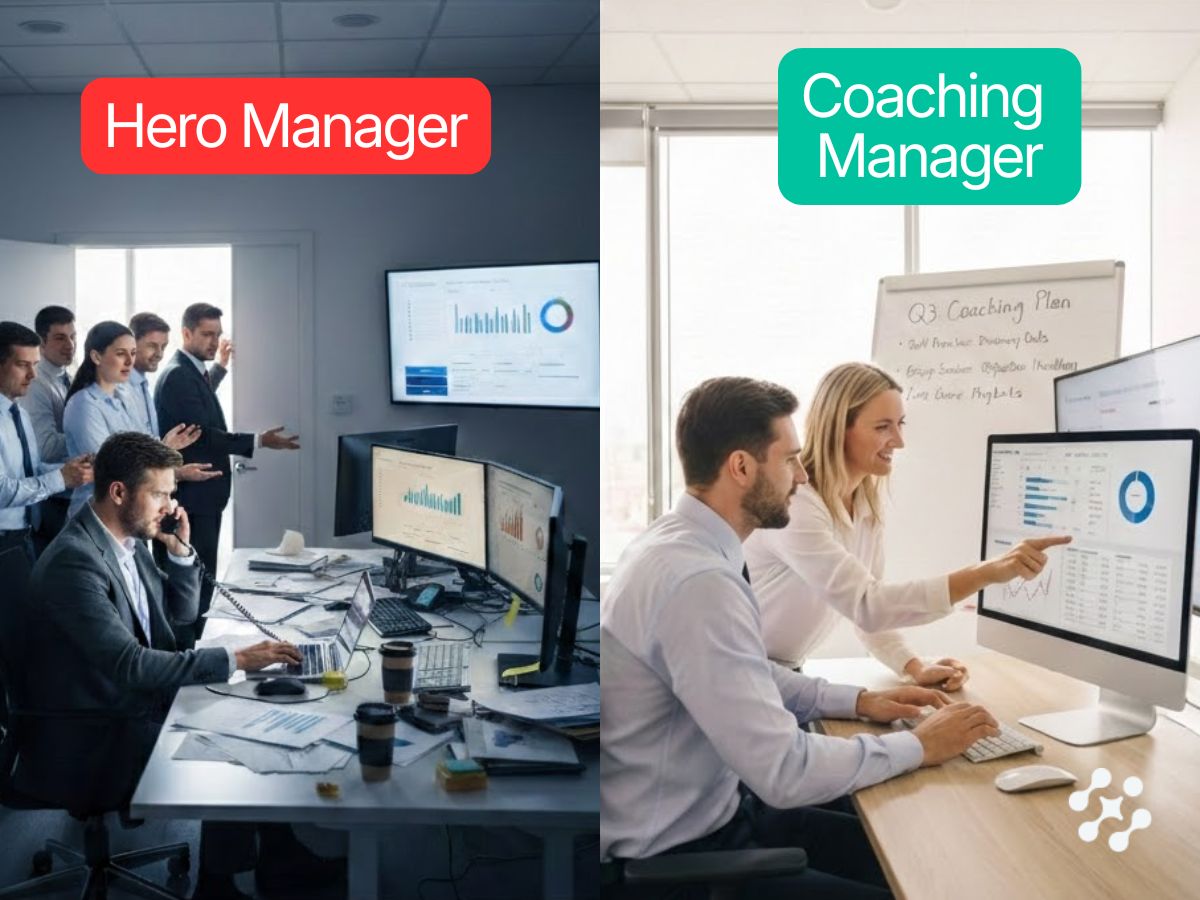
Activity Coaching:
"Sarah, make 50 calls this week and send 100 prospecting emails."
Performance Coaching:
"Sarah, your discovery-to-demo conversion rate is 42% versus the team benchmark of 68%. That 26-point gap means you're losing deals unnecessarily at discovery. If we improve this conversion rate by 20 percentage points in 60 days, you'll add $120K to your pipeline and move from 75% to 95% quota attainment. Let's focus on MEDDIC economic buyer qualification."
Why It's Different: The Comparison
Generic and Performance Coaching are different in a few key ways:
The Data That Proves Performance Coaching Works
Teams with performance-based coaching see
- 91% quota attainment, versus 85% for those without structured coaching
- 19% increase in mid-tier rep performance
- 28% higher win rates and 353% ROI on training and coaching
Teams with generic activity coaching see
- Reps improve for 2-3 weeks, then regress to baseline
- Can't prove coaching ROI (no measurement of before/after performance)
- Manager burnout (coach everyone on everything with no prioritization)
- Activity theater (reps hit call targets but conversion rates don't improve)
The shift: Stop coaching for activities. Start coaching for performance outcomes.
The 4-Step Performance Coaching Framework
This is a complete framework for performance coaching—from diagnosing performance gaps using data to sustaining improvement over time.
Follow these 4 steps to improve rep performance measurably and sustainably.
Step 1: Diagnose Performance Gaps (Use Performance Metrics, Not Gut Feel)
First, you need to identify which specific performance metrics are broken for each rep (not "rep needs to work harder").
Action 1.1: Pull Performance Metrics by Rep
Track these 5 key performance metrics:
Data sources: CRM (Salesforce, HubSpot, etc.), sales analytics platforms, or manual calculation from opportunity reports.
Time investment: 2-3 hours for initial setup (Sales Ops can automate this for ongoing tracking).
Action 1.2: Compare to Benchmark
For each metric, compare each rep to:
- Top performer benchmark (your best rep's performance)
- Team average (median performance across all reps)
- Industry benchmark (if available—average B2B win rate is 20-25%, average sales velocity is $583/day per SalesHacker)
This comparison reveals who is underperforming and by how much.
Action 1.3: Identify Root Cause
Example: Sarah's Performance Diagnosis
Sarah's diagnosis:
- Primary gap: Discovery → Demo conversion (26 percentage points below benchmark)
- Secondary gap: Avg days in discovery stage (14 days slower than top performer)
- Root cause: Not qualifying deals properly—letting unqualified prospects into pipeline without economic buyer, budget, or timeline clarity
- Skill to improve: MEDDIC qualification depth (specifically economic buyer identification)
Deliverable: Performance Gap Analysis (one page per rep showing metric gaps and root cause).
Time: 2-3 hours for initial diagnosis across 8-10 reps.
Resources: Download Performance Gap Analysis Template (tracks 5 metrics, compares to benchmark, identifies root cause).
Step 2: Target Specific Performance Skill (Not Generic "Try Harder")
Next, pinpoint which specific skills to improve to close the performance gap.
Action 2.1: Map Performance Gap to Skill
For each performance gap, identify the skill that drives that metric:
Example: Sarah
- Performance gap: Discovery → Demo conversion 42% (versus 68% benchmark)
- Root cause: Not capturing economic buyer, budget authority, or decision timeline
- Skill to improve: MEDDIC economic buyer qualification
Action 2.2: Choose ONE Performance Skill
Critical rule: Don't coach multiple skills at once. Pick the #1 skill that will move the needle most on quota attainment.
Sarah's 60-Day Focus
- One Skill: MEDDIC economic buyer qualification
- Not coaching: Demo skills, closing techniques, prospecting tactics (focus on ONE skill only)
Why? Mid-tier reps can only absorb and master one skill at a time. Coaching multiple skills simultaneously leads to...
- Cognitive overload (rep improves nothing)
- Can't isolate what worked (no clear cause-effect)
- Regression after 2-3 weeks (too many things to remember)
Action 2.3: Set Performance Improvement Target
Sarah's 60-day target
- Baseline: Discovery → Demo conversion 42%
- Target: 55% (20% improvement, moving toward 68% benchmark)
- Timeline: 60 days (8 weeks of weekly 1:1 coaching)
- Quota impact: 13 percentage-point improvement = $120K incremental pipeline = 75% → 95% quota attainment
Deliverable: Performance Improvement Plan (one-page document: ONE skill, ONE target, 60-day timeline, quota impact).
Time: 30 minutes per rep.
Step 3: Execute Performance-Based 1:1s (Focus on Outcomes, Not Just Activities)
Once you've established the gaps and skills to coach, run weekly 1:1s focused on improving the targeted performance metric.
The Performance-Based 1:1 Structure (60 minutes)
10 Minutes: Review Performance Data
- Pull up Sarah's performance metrics dashboard
- Show: "Your discovery → demo conversion rate is 42% versus 68% benchmark"
- Show: "This means you're losing 26% of deals unnecessarily at discovery"
- Connect to quota impact: "If we improve this conversion rate by 20 percentage points, you'd add $120K pipeline this quarter and move from 75% to 95% quota attainment"
- Why this matters: Makes the problem real and urgent with data, not opinions
30 Minutes: Practice Performance Skill
Weeks 1-2: Teach Framework
- Teach: MEDDIC economic buyer qualification questions
- Metrics: What metrics will define success for this project?
- Economic Buyer: Who controls the budget? Who signs the contract?
- Decision Criteria: What criteria will you use to evaluate solutions?
- Decision Process: What's the approval process? Who else is involved
- Identify Pain: What's the business impact if you don't solve this?
- Champion: Who internally will advocate for this solution?
- Roleplay: Practice asking MEDDIC questions (15 minutes)
- Feedback: "You captured metrics and pain, but you didn't probe on who the economic buyer is. Here's how to ask that question without sounding pushy..." (5 minutes)
Weeks 3-4: Review Real Performance
- Listen to 2 recorded discovery calls from the past week
- Analyze: "On this call, you asked about pain and metrics, but you didn't capture the economic buyer or decision timeline. Here's where you could have asked..."
- Practice: Roleplay the same scenario with MEDDIC questions added
- Feedback: Specific reinforcement of what's working + one adjustment for next week
Weeks 5-6: Measure Performance Improvement
- Review metric: "Your discovery → demo conversion rate is now 48%, up from 42% baseline (6-point improvement)"
- Diagnose: "What's working? What questions are getting economic buyer clarity? What's still missing?"
- Adjust: Refine technique based on what's working in the field
- Track: "I'll check your conversion rate next week—target is 50% by week 7"
Weeks 7-8: Reinforce and Sustain
- Review: "Your conversion rate is now 56% (up from 42%)—you've exceeded the 55% target"
- Celebrate: Acknowledge the 14-point improvement and $140K incremental pipeline impact
- Sustain: "What will you do to keep this conversion rate above 55%?"
- Transition: Move to bi-weekly 1:1s (skill is now habit)
10 Minutes: Create Action Plan
- Assign: "Use MEDDIC framework on your next 3 discovery calls this week"
- Track: "I'll review your call recordings and check conversion rate next Tuesday"
- Document: Add action items to CRM or coaching notes
10 Minutes: Deal Support (Optional)
- Rep's urgent questions on specific deals
- Unblock deals if needed (but keep this brief—the focus is skill coaching, not deal firefighting)
Frequency: Weekly 60-minute 1:1s for 60 days (until performance target is hit).
Deliverable: Performance-focused 1:1 sessions documented with skill practice, feedback, and metric tracking.
Time: 60 minutes per rep per week.
Step 4: Measure & Sustain Performance Improvement
Now you have a routine coaching cadence. As you move forward, make sure to tracks performance improvement weekly. This proves the coaching worked and sustains gains beyond the initial 60 days.
Action 4.1: Track Performance Weekly
Track the targeted performance metric every week during the 60-day coaching sprint:
Sarah's Performance Tracking
Tracking method: Weekly CRM export → Calculate conversion rate → Update dashboard → Review in 1:1.
Why weekly tracking matters
- Allows mid-course correction if improvement stalls
- Provides motivation (rep sees their own progress)
- Proves coaching ROI with data
Action 4.2: Calculate Performance ROI
Sarah's Performance ROI
- Baseline conversion rate: 42% (losing 26% of deals versus benchmark)
- After 8 weeks of coaching: 56% (losing only 12% of deals)
- Performance improvement: 14 percentage-point gain
- Impact: 14% more deals progress to demo stage
- Pipeline impact: $140K incremental pipeline (30 discovery calls × 14% improvement × $4.7K avg deal size)
- Revenue impact: $31K incremental closed revenue (assuming 22% win rate)
- Coaching time invested: 8 hours (8 weeks × 60 minutes per week)
- ROI: $3,875 in revenue per hour of coaching time
Why calculating ROI matters
- Justifies coaching time investment to leadership
- Helps prioritize which reps to coach next
- Proves performance coaching works (versus generic coaching)
Action 4.3: Sustain Performance Gains (Prevent Regression)
The regression problem: 62% of coached reps regress to baseline performance within 6-8 weeks if coaching stops abruptly.
How to prevent regression
1. Move to Group Coaching (Week 9+)
- Sarah has mastered the skill (56% conversion sustained for 2+ weeks)
- Move from weekly 1:1s → bi-weekly group coaching with 4-5 peers
- Group format: Share what's working, troubleshoot edge cases, reinforce best practices
- Benefit: Peer accountability + continued reinforcement without 60 min/week time investment
2. Peer Accountability
- Sarah joins "Discovery Best Practices" peer group (meets bi-weekly for 30 minutes)
- Each rep shares one discovery win + one challenge
- Group provides feedback and holds each other accountable
- Benefit: Social pressure maintains performance (no one wants to report regression to peers)
3. Self-Monitoring
- Sarah tracks her own conversion rate weekly in a personal dashboard
- If conversion rate drops below 50% for 2 consecutive weeks, she flags manager for a check-in
- Benefit: Rep takes ownership of their own performance (coaching becomes self-sustaining)
4. Quarterly Re-Calibration
- Every 90 days, review performance metrics for all coached reps
- Identify who has regressed (conversion rate dropped >10 percentage points)
- Re-engage with targeted 1:1s for 2-3 weeks to reinforce the skill
- Benefit: Catches regression early before it becomes a habit
Deliverable: Performance Improvement Dashboard (tracks baseline, weekly progress, final result, and ROI calculation).
Time: 30 minutes per week for tracking + ongoing peer coaching infrastructure.
Performance Coaching vs Activity Coaching: The Critical Difference
Most sales managers coach activities because they're easier to measure. But activity coaching doesn't improve performance; it creates performance theater.
The Side-by-Side Comparison
Why Activity Coaching Fails: The Sarah Example
- Manager: "Sarah, make 50 calls this week and send 100 prospecting emails"
- Sarah: Makes 50 calls and sends 100 emails (hits activity target)
- Result: Still converting at 42% discovery → demo (performance unchanged)
- Problem: Sarah was busy, but the root cause (poor qualification) wasn't addressed
- Activity theater: High activity, zero performance improvement
Why Performance Coaching Works: The Sarah Example
- Manager: "Sarah, your discovery → demo conversion is 42% versus 68% benchmark. That 26-point gap is costing you $120K in pipeline. Let's improve conversion to 55% in 60 days by mastering MEDDIC economic buyer qualification."
- Sarah: Focuses on qualification skill for 8 weeks (weekly 1:1 practice and feedback)
- Result: Conversion rate improves to 56% (14-point gain, performance improved ✅)
- Impact: $140K incremental pipeline + move from 75% to 95% quota attainment
- Performance improvement: Targeted skill coaching creates measurable revenue impact
The Insight
You can hit all your activity targets and still miss quota.
Activity coaching creates the illusion of progress (high call volume, high email volume) without improving the metrics that actually drive revenue (conversion rates, velocity, win rate).
Performance coaching ties every coaching hour directly to revenue outcomes. If the metric doesn't improve, the coaching isn't working—and you adjust.
Real Example: How Performance Coaching Improved Mid-Tier Reps by 24%
Company Profile:
- Stage: Series B SaaS company, $30M ARR
- Team: 25 sales reps (8 top performers, 10 mid-tier, 7 underperformers)
- Problem: 10 mid-tier reps stuck at 70-80% of quota for 2+ quarters despite ongoing coaching
The Situation (Before Performance Coaching)
David, a Sales Manager with 10 mid-tier reps, had been coaching his team for 6 months. But performance wasn't improving.
What David was doing (Activity Coaching)
- Weekly 1:1s focused on activities: "Make 50 calls this week, send 100 emails, schedule 5 demos"
- Generic advice: "Be more persistent. Ask better questions. Create more urgency."
No performance measurement: Assumed coaching was working because 1:1s were happening
- No prioritization: Tried to coach everyone on everything (discovery, demo, closing, prospecting)
Result: Mid-tier reps still at 70-80% of quota after 6 months of coaching. Avg quota attainment: 74%.
David's frustration: "I'm spending 10 hours per week in 1:1s, but performance isn't improving. I don't know what else to do."
The Solution: Performance Coaching Framework
David switched to performance coaching using the 4-step framework:
Step 1: Diagnose (Week 1)
- Pulled performance metrics for all 10 mid-tier reps (pipeline coverage, stage conversion rates, velocity, win rate)
- Found: Average discovery → demo conversion was 44% (versus 68% for top performers)
- Root cause: Reps weren't qualifying economic buyer or timeline—letting unqualified prospects into pipeline
Step 2: Target (Week 2)
- Target skill: MEDDIC economic buyer qualification
- Target performance: 44% → 58% conversion (20% improvement)
- Timeline: 8 weeks of focused coaching
- Prioritization: Coach top 5 priority reps first (highest quota at risk)
Step 3: Execute (Weeks 3-10)
- Performance-based 1:1s with top 5 reps (60 minutes weekly)
- Week 1-2: Teach MEDDIC framework
- Week 3-4: Review call recordings and roleplay
- Week 5-6: Track conversion rate improvement
- Week 7-8: Reinforce and sustain
- Track conversion rate weekly for all 10 reps
Step 4: Measure (Weeks 4-10)
- Week 4: 44% → 49% conversion (5-point improvement)
- Week 6: 49% → 53% conversion (on track to target)
- Week 8: 53% → 56% conversion (near target)
- Week 10: 56% → 59% conversion (target exceeded by 1 point!)
The Performance Coaching Results
Metric: Discovery → Demo Conversion | Before (Baseline): 44% | After (Week 10): 59% | Improvement: +34%
Metric: Avg Days in Discovery Stage | Before (Baseline): 36 days | After (Week 10): 26 days | Improvement: -28% (10 days faster)
Metric: Team Quota Attainment (Avg) | Before (Baseline): 74% | After (Week 10): 91% | Improvement: +23% (17 points)
Metric: Pipeline Generated per Rep | Before (Baseline): $420K/qtr | After (Week 10): $450K/qtr | Improvement: +7%
Metric: Pipeline Converted to Revenue | Before (Baseline): $160K/qtr | After (Week 10): $210K/qtr | Improvement: +31%
The Key Insight
"We were coaching activities for 6 months and nothing changed. Once we switched to performance coaching—diagnosing the exact metric gap, targeting one skill, and tracking improvement weekly—our mid-tier reps improved 24% in 10 weeks. The difference was night and day."— David, Sales Manager
Why It Worked
- Data-driven diagnosis revealed the exact skill gap (MEDDIC qualification)
- ONE skill focus allowed reps to master it (not overwhelm with 5 skills at once)
- Weekly tracking showed progress and allowed mid-course corrections
- Measurable ROI proved coaching worked ($50K incremental revenue per rep coached)
5 Common Performance Coaching Mistakes and How to Avoid Them
Even with the best intentions, sales managers make these mistakes when implementing performance coaching:
Mistake #1: Coaching Activities Instead of Performance
Why Teams Do This
- Activities are easier to measure (calls, emails, meetings logged in CRM)
- "Make 50 calls" is concrete and feels actionable versus "improve conversion rate"
- Managers mistake motion for progress
The Consequence
- Activity theater (reps are busy but performance doesn't improve)
- Reps hit activity targets but still miss quota
- Can't prove coaching ROI (no performance measurement)
The Fix
Always tie coaching to a performance metric (conversion rate, velocity, win rate, pipeline coverage).
Example: Instead of "Make 50 calls," say "Your discovery → demo conversion is 42%. Let's improve it to 55% in 60 days by mastering MEDDIC qualification. That will add $120K to your pipeline."
If the performance metric doesn't improve after 4 weeks, the coaching isn't working. Adjust your approach.
Mistake #2: No Performance Baseline
Why Teams Do This
- Managers jump straight to coaching without establishing baseline performance
- "Let's work on discovery skills" (but what's your current discovery → demo conversion rate?)
- Assume coaching is working because 1:1s are happening
The Consequence
- Can't measure if coaching improved performance (no before/after comparison)
- Rep doesn't see tangible progress (no motivation)
- Manager can't prove coaching ROI to leadership
The Fix
Always establish baseline performance before coaching begins:
Sarah's baseline: Discovery → demo conversion 42%, avg days in discovery 35
After 8 weeks of coaching: 56% conversion, avg days 24 (14-point improvement, 11 days faster)
Now you can prove coaching worked with data, not opinions.
Mistake #3: Coaching Multiple Performance Gaps at Once
Why Teams Do This
- Managers see 5 performance gaps and try to fix all of them simultaneously
- "Sarah needs help with discovery, demo delivery, objection handling, closing, and prospecting"
- Try to maximize coaching efficiency by covering multiple topics in each 1:1
The Consequence
- Rep overwhelmed with too many things to improve (improves nothing)
- Can't isolate what worked (was it discovery coaching? demo coaching? closing coaching?)
- Regression within 2-3 weeks (too many new behaviors to sustain)
The Fix
Coach one performance metric per 60-day sprint.
Sarah's 60-day focus: Discovery → demo conversion ONLY (not demo skills, not closing, not prospecting)
Once Sarah masters discovery qualification (8 weeks), move to the next performance gap. One skill at a time = mastery. Five skills at once = mediocrity.
Mistake #4: Not Connecting Performance Improvement to Quota Impact
Why Teams Do This
- Managers coach metrics in isolation
- "Your discovery → demo conversion is 42%" (so what? why does that matter?)
- Rep doesn't understand the business impact of improving this metric
The Consequence
- Rep doesn't feel urgency to improve (it's just another metric)
- No motivation to practice the skill (doesn't connect to their paycheck)
- Coaching becomes a box-checking exercise
The Fix
Always connect performance improvement to quota impact and revenue.
Example: "Sarah, your discovery → demo conversion is 42% versus 68% benchmark. That 26-point gap is costing you $120K in pipeline this quarter. If we improve your conversion rate by 20 points, you'd move from 75% quota attainment to 95%—that's an extra $50K in commission for you."
Make it personal. Show the rep how improving this metric directly impacts their quota attainment and earnings.
Mistake #5: Letting Performance Regress After Initial Improvement
Why Teams Do This
- Rep improves for 8 weeks and hits target performance
- Manager stops coaching abruptly (assumes improvement will stick automatically)
- No sustainability plan to reinforce the new behavior
The Consequence
- Rep regresses to baseline performance within 4-6 weeks (62% of coached reps regress without reinforcement)
- Performance gains are temporary, not permanent
- Team is back to square one after 2 months
The Fix
Use Step 4: Sustain gains through...
- Group coaching. Move from 1:1 to bi-weekly peer group after week 8)
- Peer accountability (rep joins "Discovery Best Practices" group with 4-5 peers)
- Self-monitoring (rep tracks their own conversion rate weekly)
- Quarterly re-calibration (if conversion drops >10 points, re-engage with 2-3 weeks of 1:1s)
Performance coaching isn't a one-time event. It's an ongoing system.
Next Steps: Start Performance Coaching This Week
Don't wait for next quarter. Start performance coaching this week with these immediate actions:
This Week (2-3 Hours)
1. Pull Performance Metrics (Step 1)
- Export 90 days of deal data from your CRM (Salesforce, HubSpot, Pipedrive)
- Calculate by rep: Pipeline coverage, stage conversion rates, avg days per stage, win rate
- Compare each rep to top performer benchmark and team average
- Time: 2-3 hours (or ask Sales Ops to automate this dashboard)
- Resource: Download: Performance Metrics Template (tracks 5 key metrics by rep)
2. Diagnose Performance Gaps (Step 1)
- For each rep, identify which performance metric is below benchmark
- Determine root cause (why is this metric broken?)
- Map performance gap → skill to improve
- Time: 1 hour for 8-10 reps
- Resource: Download: Performance Gap Analysis Template (diagnose root cause, identify skill gap)
Next Week (30 Minutes Per Rep)
3. Target Performance Skill (Step 2)
- For your top 3 priority reps (highest quota at risk, coachable, motivated), choose ONE skill to improve
- Set performance improvement target: Baseline → 20% improvement in 60 days
- Calculate quota impact: How much pipeline or revenue will this create?
- Time: 30 minutes per rep (1.5 hours total for 3 reps)
- Resource: Download: Performance Improvement Plan Template (ONE skill, ONE target, 60-day plan)
4. Schedule First Performance-Based 1:1 (Step 3)
- Block 60 minutes on calendar for weekly 1:1 with each priority rep
- Prepare: Pull up rep's performance metrics, prepare MEDDIC framework training, queue up call recording for review
- Use structure: 10 min data review → 30 min skill practice → 10 min action plan → 10 min deal support
- Time: 60 minutes per rep per week for 8 weeks
- Resource: Download: Performance-Based 1:1 Template (agenda structure, roleplay prompts, feedback framework)
Next 60 Days (Ongoing)
5. Execute & Measure (Steps 3-4)
- Run weekly performance-based 1:1s with top 3 priority reps
- Track performance metric weekly (update dashboard every Monday)
- Celebrate milestones: Week 4 (10% improvement), Week 6 (15% improvement), Week 8 (20% target hit)
- Calculate ROI: Performance improvement × pipeline impact × win rate = revenue generated per hour of coaching
- Time: 3 hours per week (3 reps × 60 min each)
- Resource: Download: Performance Improvement Tracker (weekly metric tracking, ROI calculation)
Performance Coaching: The Bottom Line
Generic coaching keeps your mid-tier reps stuck at 75% of quota. Performance coaching moves them to 95%.
Performance coaching uses data to diagnose gaps, targets one specific skill tied to a metric, tracks measurable improvement weekly, and sustains gains through peer accountability and self-monitoring.
You can pull performance metrics this week. You can diagnose gaps in one hour. You can schedule your first performance-based 1:1 this Friday.
The question isn't "Do I have time for performance coaching?" The question is: "Can I afford to keep coaching activities that produce no measurable results?"
Ready to see which performance metrics your reps need to improve? Tools like Chief surface performance gaps automatically. Chief flags exactly which metric each rep needs to improve, and then triggers coaching actions based on real-time signals.
Related Guides
- Sales Coaching for Managers: The Practical Guide - A complete framework for building a high-performing sales team