.svg)
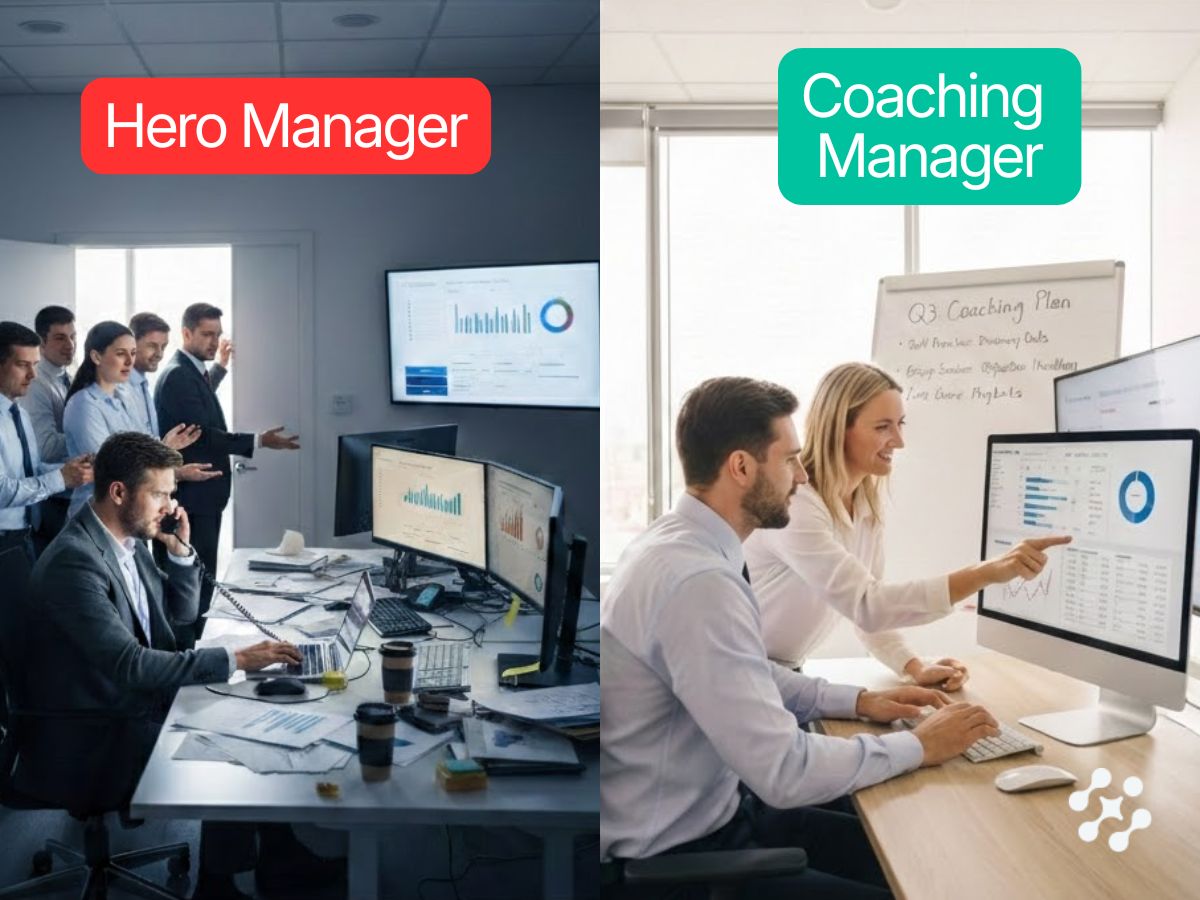

You were promoted to Sales Manager 6 months ago. You're managing 15 reps. And you're drowning.
Your calendar is back-to-back: deal reviews, pipeline calls, 1:1s, firefighting. You know you should be coaching more, but you don't have time.
When you do coach, it's reactive; you jump on a stalled deal instead of proactively developing skills. And you have no idea if it's working.
If this sounds familiar, there's one explanation: you were never taught how to coach.
Most sales managers struggle with the same challenges:
- Time: "I don't have time to coach 15 reps." You're spending 80% of your time on deals, 20% on coaching (that should be reversed).
- Prioritization: "Who do I coach first?" You coach the squeaky wheels (whoever yells loudest), not the reps who need it most.
- Structure: "What does a good 1:1 even look like?" You wing it, and you end up doing deal reviews instead of actual coaching.
- Scalability: "Coaching 5 reps was manageable; 15 feels impossible." You get overwhelmed, and put out fires instead of coaching.
- Measurement: "How do I know if coaching is working?" Without quality data, you coach on gut feel, not reality.
What's the root cause of these challenges? You're managing like a "super rep" (doing deals) instead of a manager and a leader (developing people).
What You'll Learn in this Guide
The goal of this guide is to help you demystify and overcome these sales coaching challenges.
We'll discuss...
- How much time to spend coaching
- Who and how to prioritize
- How to structure effective 1:1s
- How to scale coaching from 5 to 15+ reps without burning out
Why Coaching Is Your #1 Job (Not Deals)
You were promoted because you were a great rep. You crushed quota at 120%+ for three years straight. You closed big deals. You were in the field, winning.
Managing a team is a fundamentally different job.
As a rep: Your success = your quota attainment. You controlled your pipeline, your activities, your results.
As a manager: Your success = your team's quota attainment. You can't close 15 deals at once; you have to develop 15 people who can.
The Manager Identity Crisis
There's one trap most new managers fall into: they try to "be in every deal." They do this because it's what they know. You become a "super rep," running deals for your team instead of teaching them how to do it.
The results of this approach are catastrophic:
- You burn out (you can't be in 15 deals simultaneously).
- Your team underperforms (reps never learn, they wait for you to save their deals).
- Your credibility suffers (you're not scalable past 10-15 reps).
- You don't get promoted (you can't demonstrate people development skills).
The Data on Coaching Impact
The business case for prioritizing coaching is overwhelming.
Teams with consistent coaching...
- Hit 76% quota attainment with weekly coaching versus 56% with monthly coaching and 47% with quarterly or less coaching
- Achieve 28% higher quota attainment overall compared to teams without structured coaching programs
- See 32% higher win rates than teams with inconsistent coaching
- Close deals 19-22% faster with regular skill development
- Experience 40% better retention—reps who receive regular coaching are significantly more likely to stay beyond two years
Teams without consistent coaching...
- Hit only 89% of quota on average (versus 105% with high-quality coaching)
- See higher rep turnover (reps leave for "better coaching" elsewhere)
- Get managers stuck in "super rep" mode (not promotable past 10-15 reps)
- Get inconsistent performance across the team
The Coaching Gap
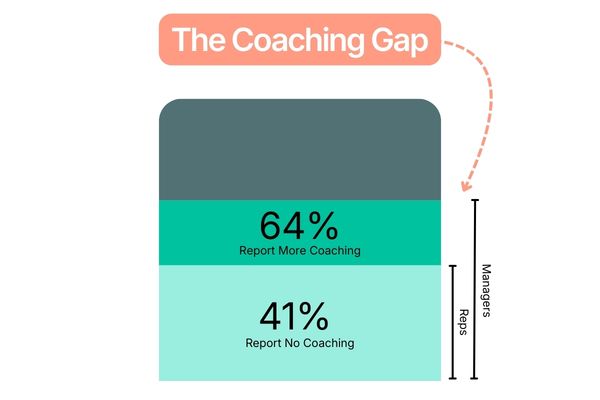
There's a disconnect between how managers and reps see coaching. While 64% of sales leaders believe they're spending more time coaching than a year ago, 41% of sales reps report they are never or rarely coached. With only 27% of reps hitting quota overall, this coaching gap represents a massive performance opportunity.
The stakes are clear: Your #1 job as a manager is to help your reps do their jobs better. Everything else (pipeline reviews, forecasting, deal firefighting) is secondary.
The shift you need to make is fundamental: Stop being the hero who closes deals. Start being the coach who develops people who close deals.
How Much Time Should You Spend Coaching?
Now that you know coaching is the most important part of your job, you might be wondering how much time to dedicate to it.
It depends on your team size.
Best-in-class managers spend 25-40% of their time coaching. Average managers spend 12-15%. Here's the exact breakdown by team size.
Managing 5 Reps: The Simple Situation
The Manager Challenge
Ten reps represents the tipping point where coaching starts breaking down if you don't change your approach. Managers who try to maintain the same 1-hour 1:1 structure that worked at 5 reps burn out within 8-12 weeks, and coaching stops entirely.
Time Allocation
- Total coaching time: 5-6 hours/week (25%)
- Per rep: 1 hour/week (60-minute 1:1s)
- Format: 100% 1:1 coaching (deep, personalized sessions)
Why This Works
- One hour per rep is enough time to diagnose skill gaps, practice skills through roleplay, and review progress from previous sessions.
- You have bandwidth for deep coaching (not just surface-level deal reviews).
- Reps feel supported with consistent weekly touchpoints.
- You can still handle other responsibilities without burning out.
When to Worry
- If you're spending <4 hours/week coaching 5 reps, you're under-coaching
- If you're spending >8 hours/week coaching, you're over-managing (reps need autonomy)
Managing 10 Reps: The Tipping Point
Time Allocation
- Total coaching time: 8-10 hours/week (20-25%)
- Per rep: 30-45 minutes/week (can't sustain 1-hour sessions for everyone)
- Format: 70% 1:1, 20% group coaching, 10% self-serve resources
What Changes at 10 Reps
This is where most managers hit a wall. You can't do 60-minute 1:1s with everyone (that would be 10 hours/week minimum, plus prep time).
You need to…
- Shorten 1:1s to 30-45 minutes for most reps while maintaining weekly frequency
- Introduce group coaching for common skill gaps (e.g., if 5 reps struggle with objection handling, run a 60-minute group workshop instead of five separate 1:1s)
- Prioritize coaching time using an urgency × impact × coachability matrix (detailed below)
- Create self-serve resources
- for basic skills (recorded playbooks, templates, checklists)
Managing 15 Reps: The Scalability Test
Time Allocation
- Total coaching time: 10-12 hours/week (25-30%)
- Per rep: 20-30 minutes/week (highly prioritized allocation)
- Format: 50% 1:1, 30% group coaching, 20% self-serve enablement
What Changes at 15 Reps
You cannot coach everyone 1:1 every week. There simply isn't enough time. Instead, you need a sophisticated coaching triage system:
- Top 5 priority reps get 30-minute 1:1s weekly (using the prioritization matrix below)
- Middle tier reps get group coaching or 30-minute 1:1s bi-weekly
- Bottom tier reps (already crushing quota or low coachability) get self-serve resources and monthly check-ins
- Build scalable resources: recorded playbooks, peer shadowing programs, templates that reps can access on-demand
The Reality of 15 Reps
This is the maximum team size for one manager to coach effectively. Beyond 15 reps, you need either...
- A second manager to divide the team
- An enablement specialist to handle group coaching
- Or accept that coaching will stop entirely (which shows up in declining quota attainment within 2-3 quarters)
The Math
- 15 reps × 30 min = 7.5 hours/week minimum
- Add group coaching (3 hours) = 10.5 hours/week
- Add self-serve prep (2 hours) = 12.5 hours/week
- Total: 25-30% of your time dedicated to coaching
If you're unwilling or unable to invest this time, you have too many direct reports.
How to Prioritize Reps to Coach When You Don't Have Time for Everyone
At 5 reps, you can coach everyone equally. At 15 reps, you can't. You need a prioritization framework to focus your limited coaching time on the reps who will benefit most.
Use this 3-factor matrix: Urgency × Impact × Coachability.
Factor #1: Urgency
Why It Matters
High-urgency reps need coaching now. You can't wait until next quarter when they've already missed. Low-urgency reps can be coached proactively with less time pressure.
What It Measures
- Is this rep at risk of missing quota this quarter?
- Are their deals stalling? Is their pipeline coverage dropping below critical thresholds?
- Do they need intervention now, or can coaching wait until next quarter?
Urgency Levels
- High Urgency: Rep at 70-85% of quota year-to-date, at risk of missing Q4 target. Immediate coaching can save the quarter.
- Medium Urgency: Rep at 85-95% of quota, could miss if negative trends continue. Coaching is important but not critical.
- Low Urgency: Rep at 95%+ of quota, on track to hit or exceed target. Coaching can be proactive and developmental.
Factor #2: Impact
Why It Matters
When you only have 10 hours/week for coaching, focus on high-impact reps first. A 10% improvement on a $400K quota rep (4 hours of coaching) delivers more team value than a 10% improvement on a $150K quota rep (same 4 hours).
What It Measures
- Will coaching this rep move the team number?
- What's their quota? What's the revenue upside if they improve?
- How much incremental revenue can coaching unlock?
Impact Levels
- High Impact: Rep has $400K+ annual quota. Moving them from 85% → 100% = $60K incremental revenue. Large lever for team performance.
- Medium Impact: Rep has a $250K quota. Moving them from 85% → 100% = $37.5K incremental revenue. Meaningful but smaller upside.
- Low Impact: Rep has a $150K quota or is already at 110% of quota. Smaller revenue opportunity from coaching investment.
This isn't about valuing people differently; it's about math. When coaching time is constrained, prioritize where it moves the team number most.
Factor #3: Coachability
Why It Matters
High-coachability reps improve fast, so your coaching investment pays off quickly in the form of changed behaviors and better results.
Low-coachability reps drain coaching time with minimal improvement. After 2-3 coaching sessions without behavioral change, you're better off moving them to a performance improvement plan (PIP) rather than continuing to invest coaching time that isn't working.
What It Measures
- Will this rep respond to coaching?
- Are they coachable (open to feedback, learning quickly) or defensive?
- Do they have a growth mindset or fixed mindset?
Coachability Levels
- High Coachability: Rep actively asks for help, applies feedback immediately, shows measurable improvement after coaching sessions. High return on coaching investment.
- Medium Coachability: Rep is receptive to feedback but slow to change behaviors. Improvement happens over weeks/months, not days.
- Low Coachability: Rep is defensive when given feedback, doesn't apply coaching, shows no improvement after multiple sessions. Low or negative ROI on coaching time.
The Coaching Prioritization Matrix
How to Use It
Score each rep on all three factors (High/Medium/Low), then prioritize coaching time accordingly.
Example Priority Ranking
The Prioritized Action Plan
- Top 3 Priority Reps: Get 45-60 min 1:1 coaching weekly with dedicated prep and follow-up
- Priority 4-6: Get 30-min 1:1s bi-weekly OR weekly group coaching sessions
- Priority 7+: Get self-serve resources, peer shadowing, and monthly check-ins
Important Notes
- Re-evaluate monthly: Priorities shift as performance changes. The rep who was #6 in January might be #2 in March if their pipeline coverage drops.
- Communicate transparently: Don't hide the prioritization. Explain: "You're crushing quota at 110%, so we'll meet bi-weekly instead of weekly. If anything changes or you need more support, we'll adjust."
- Low coachability ≠ bad person: Some reps won't respond to your coaching style, the current role, or this moment in their career. That's fine, but continuing to invest scarce coaching time with zero ROI isn't helping them or the team.
How to Structure a Sales Coaching 1:1 (30 Min vs 60 Min)
Most managers wing their 1:1s. They end up doing deal reviews ("How's the XYZ deal?") instead of actual coaching.
This is the exact structure for 30-minute and 60-minute coaching 1:1s that develop skills, not just inspect pipeline.
The 60-Minute 1:1 Structure (For Priority Reps)
When to Use This
- Priority reps (high urgency × high impact × high coachability)
- Team size: 5-8 reps (enough time for weekly 60-min sessions)
- Frequency: Weekly
Structure
Minutes 0-10: Review Data (Not Deals)
Start with performance data, not deal status.
Pull up the rep's metrics: pipeline coverage, stage conversion rates, average days in each stage, activity levels.
Show specific performance gaps: "Your discovery → demo conversion rate is 42% versus our 65% benchmark. Let's talk about why."
Ask the rep to diagnose first: "What do you think is causing this drop?"
Goal: Diagnose performance gaps using data (not gut feel or deal inspection). Get rep ownership of the problem.
Minutes 10-40: Practice Skill (Roleplay)
This is the heart of coaching—actual skill practice in a safe environment.
- Pick ONE specific skill to improve based on the data (e.g., discovery qualification depth, objection handling, multi-threading)
- Teach the framework or tactic (5 min)—give them the structure (e.g., MEDDIC economic buyer questions, specific objection handling language patterns)
- Roleplay the skill (20 min)—manager plays the prospect, rep practices the skill in real-time
- Provide real-time feedback (5 min)—"What worked well? What would you change? Let me show you one adjustment..."
Goal: Rep practices the skill in a low-stakes environment, gets immediate feedback, builds muscle memory before using it on real calls.
Minutes 40-50: Create Action Plan
Translate coaching into specific actions for the next week:
- Assign 3 specific actions: "Use these MEDDIC economic buyer questions on your next 3 discovery calls. I want you to record them."
- Define measurement: "How will we measure improvement? Did your discovery → demo conversion rate improve? Did average days in the Discovery stage drop?"
- Schedule accountability: "We'll review those 3 recorded calls in next week's 1:1. Come prepared to self-assess."
Goal: Clear accountability with measurable progress tracking.
Minutes 50-60: Rep's Questions/Concerns
Open the floor for anything the rep needs: "What do you need help with? Any deals stuck that we should strategize?"
Keep deal support brief (10 minutes max). If a deal needs extended discussion, schedule a separate 30-minute deal strategy session. Don't let deal reviews hijack the coaching 1:1.
Key Rule:
80% of 1:1 time should be coaching (skill practice, feedback, development). Only 20% should be deal review (support, unblocking). If your 1:1s are 80% deal review and 20% coaching, you're not coaching, you're inspecting.
The 30-Minute 1:1 Structure (For Larger Teams)
When to Use This
- Team size: 10+ reps (can't sustain 60-minute sessions for everyone)
- Medium-priority reps (still important but less urgent than top tier)
- Frequency: Weekly or bi-weekly
Structure
Minutes 0-5: Quick Data Review
Review 1-2 key metrics (not 5-6—stay focused).
Identify the gap: "Your demo → proposal conversion dropped to 38% last month. That's down from your 52% baseline. Let's fix that."
Minutes 5-20: Targeted Coaching
Focus on ONE specific skill only (no time for multiple topics).
- Brief teach (5 min): "Here's the framework for demo-to-proposal transitions..."
- Quick roleplay (10 min): "Let's practice your demo-to-proposal transition right now. I'm the prospect who just saw your demo..."
- Feedback (5 min): "What worked? What would you adjust?"
Minutes 20-25: Action Plan
Assign 2-3 specific actions for next week:
"Use this transition language on your next 2 demos. Record them. We'll review in our next session."
Minutes 25-30: Deal Support (If Needed)
"Any critical blockers I can help with right now?"
Keep it brief. If it needs more than 5 minutes, schedule a separate deal strategy session.
Key Differences from 60-Minute 1:1s:
- Less time for deep roleplay (10 min vs 20 min)—keep it focused and fast-paced.
- More focused topic selection (ONE skill only, not 2-3)
- Faster pace—rep needs to come prepared with self-assessment and specific questions
- More frequent check-ins—30-minute sessions work best when done weekly, not bi-weekly
Common 1:1 Mistakes to Avoid
Mistake #1: Letting Deal Reviews Hijack the 1:1
The rep brings up a stalled $100K deal in minute 3. You spend 25 minutes strategizing the deal. No coaching happens.
Fix: Set the agenda upfront. "First 20 minutes: coaching on discovery qualification. Last 10 minutes: deal support." Hold the boundary.
Mistake #2: Talking More Than the Rep
You spend 25 minutes telling war stories about how you closed similar deals. The rep nods politely.
Fix: Use the 80/20 rule—rep should talk 80% of the time (self-diagnosing, practicing, problem-solving). You talk 20% (asking questions, giving targeted feedback).
Mistake #3: No Follow-Up on Previous Action Items
Last week you assigned 3 specific actions. This week you start fresh with a completely different topic. No accountability for whether they did the work.
Fix: Start every 1:1 with: "Last week we focused on X. You were going to do Y. How did it go? What did you learn?"
How to Scale Coaching from 5 Reps to 15+
If you’re trying to grow your team, it’s best to use 3 coaching models strategically: 1:1 (high-touch), Group (medium-touch), and Self-Serve (low-touch, scalable).
Coaching Model #1: 1:1 Coaching (High-Touch)
When to Use This
- Priority reps (high urgency × high impact based on matrix above)
- Complex performance gaps requiring personalized diagnosis
- Reps with high coachability (fast improvement, high ROI)
Time Investment
30-60 minutes per rep per week.
Scaling Limit
You can do 1:1 coaching for maximum 8-10 reps at 60 minutes each (8-10 hours/week).
Beyond 10 reps, you need to triage: top 5 get 1:1, others get group or self-serve coaching.
Coaching Model #2: Group Coaching (Medium-Touch)
When to Use This
- 5+ reps have the same performance gap (e.g., all struggle with objection handling, discovery qualification, or multi-threading)
- Medium-priority reps (not urgent, but still need skill development)
- Situations where peer learning adds value (reps learn from each other's approaches)
Format
45-60 minute group workshop with 5-8 reps
Structure
15 min: Teach framework or best practice
30 min: Group roleplay (pairs practice while you observe and coach)
15 min: Group Q&A and key takeaways
Frequency: Bi-weekly or monthly
Time Investment
- 1 hour teaches 5-8 reps simultaneously (versus 5-8 hours for individual 1:1s)
- 5-8x more time-efficient than 1:1 coaching
Scaling Advantage
- More efficient use of coaching time
- Peer accountability (reps practice together, hold each other accountable)
- Builds team learning culture (reps share what works)
Example Topics for Group Coaching
- Objection handling roleplay workshop
- Discovery question framework practice
- Multi-threading strategy session
- Demo-to-close transition techniques
Coaching Model #3: Self-Serve (Low-Touch, High-Scale)
When to Use This
- Team size of 15+ reps (can't do 1:1 for everyone)
- Common/foundational gaps that don't require personalized coaching (e.g., product knowledge, basic qualification frameworks)
- Low-priority reps (already hitting quota, low urgency for immediate coaching)
Format
- Recorded playbooks: 10-15 minute videos explaining frameworks (e.g., "Discovery Framework Deep Dive," "MEDDIC Qualification Process")
- Templates/Checklists: MEDDIC qualification checklist, objection handling response library, discovery call structure template
- Peer shadowing programs: New reps or struggling reps shadow top performers on 3-5 calls
- Self-assessment tools: Reps evaluate their own calls using a rubric, identify gaps independently
Time Investment (Manager)
- 2-3 hours to create each resource (one-time investment)
- 0 hours ongoing (reps self-serve)
- 30 minutes monthly to review usage and update content
Scaling Advantage
- One resource serves 50+ reps
- Reps learn at their own pace and on their own schedule
- Frees manager time for high-priority 1:1 coaching
- Builds rep autonomy and self-directed learning
Examples of Self-Serve Resources
- Recorded "Discovery Call Breakdown" analyzing a real call with annotations
- MEDDIC qualification template with example questions
- Objection handling library with 20+ common objections and proven responses
- New rep onboarding playbook (self-paced learning path)
The Scaling Path: How Coaching Mix Changes by Team Size
Key Insight
As your team grows, you shift from 1:1 (high-touch, low-scale) to group + self-serve (lower-touch, higher-scale). This isn't about caring less; it's about using your limited time strategically so coaching doesn't stop entirely when you hit 12-15 reps.
The managers who successfully scale to 15-20 reps without burning out master all three models and know when to use each.
Real Example: How a Manager Scaled Coaching from 8 to 16 Reps
Manager Profile
- Name: David
- Company: Series B SaaS company, mid-market segment
- Team Size: Started with 8 reps, grew to 16 reps over 18 months
- Problem: Coaching worked great at 8 reps. At 16 reps, coaching stopped entirely and quota attainment dropped.
The Situation (Before): Coaching at 8 Reps
David was promoted to Sales Manager with 8 reps reporting to him. He implemented weekly 60-minute 1:1s with each rep (8 hours/week total coaching time).
His approach
- 60-minute 1:1s every week
- Data review → skill practice → action planning
- Strong focus on roleplay and real-time feedback
Results at 8 reps
- Team hit 104% of quota
- Reps showed consistent improvement in targeted skills
- David felt in control and effective
- Manager time: 8 hours/week on coaching (20% of his time)
The Problem: Team Growth to 16 Reps
The company grew, territory expanded, and the team doubled from 8 to 16 reps over 12 months.
David tried to maintain the exact same approach: 60-minute 1:1s with everyone, every week.
The math didn't work:
- 16 reps × 60 min = 16 hours/week required for coaching
- That's 40% of his week—plus he still had pipeline reviews, forecasting, deal strategy, hiring, and firefighting.
- David attempted this schedule for 8 weeks, burned out completely, and coaching stopped.
Results at 16 reps (same approach)
- Coaching collapsed to zero (David couldn't maintain 16 hours/week)
- Team quota attainment dropped to 89%
- Reps complained about lack of support and development
- David considered quitting management and going back to individual contributor role
The Solution: Implementing the Scaled Coaching Model
David implemented the 1:1 + Group + Self-Serve approach:
1:1 Coaching (30% of coaching time):
- Identified top 5 priority reps using urgency × impact × coachability matrix
- 45-minute 1:1s bi-weekly (not weekly—stretched time but maintained quality)
- Time investment: 4 hours/week for high-priority individual coaching
Group Coaching (40% of coaching time):
- Identified common skill gaps across multiple reps (discovery depth, objection handling, multi-threading)
- Ran two 60-minute group workshops per month with 8 reps each
- Topics rotated based on quarterly skill priorities
- Time investment: 4 hours/month = 1 hour/week average
Self-Serve Resources (30% of coaching time):
- Recorded 6 core playbooks: discovery framework, demo structure, objection handling, proposal process, negotiation tactics, multi-threading strategy
- Created templates for MEDDIC qualification, discovery questions, competitive objections
- Built peer shadowing program (new reps shadow top 2 performers on 5 calls each)
- Time investment: 6 hours to create resources (one-time), 0 hours ongoing, 30 min/month to update
Total Coaching Time After Scaling:
- 5 hours/week (versus 0 hours when he tried to maintain 16 hours/week)
- Sustainable and consistent over 6+ months
The Results: 60 Days After Implementing Scaled Model
The Key Insight
David's reflection after 6 months:
"I can't coach 16 reps the same way I coached 8. I tried, and coaching stopped entirely. Once I mixed 1:1, group, and self-serve strategically, I could scale coaching without burning out. My top 5 priority reps get more focused attention than they did before, and everyone else still gets consistent development through group sessions and resources. Team performance recovered within one quarter."
Why It Worked
- Accepted reality: Can't do 1:1 with 16 people every week
- Prioritized ruthlessly: Top 5 reps got premium coaching time
- Built scalable systems: Group and self-serve filled the gap
- Measured impact: Tracked coaching hours, quota attainment, rep feedback
- Stayed consistent: Maintained 5 hours/week for 6+ months (versus swinging between 16 hours and 0 hours)
5 Common Mistakes New Sales Managers Make
Mistake #1: Trying to Coach Everyone Equally
Why Managers Do This
They want to be “fair:” everyone gets the same coaching time, same attention, same investment. It feels equitable.
The Consequence
The manager spreads coaching time too thin. Everyone gets 15 minutes, nobody gets enough coaching to actually improve. High-urgency, high-impact reps don't get the intensive support they need to close the performance gap.
Meanwhile, reps already crushing quota at 115% get the same time as reps struggling at 75%, wasting coaching time that could be better invested.
The Fix
Use the urgency × impact × coachability matrix to prioritize. Top 3-5 priority reps should get 60-80% of your coaching time. Everyone else gets group coaching or self-serve resources.
Communicate this transparently: "You're at 110% of quota, so we'll shift to bi-weekly 1:1s. If anything changes or you need more support, let me know immediately and we'll adjust."
Mistake #2: 1:1s Become Deal Reviews Instead of Coaching
Why Managers Do This
The rep brings up a stalled $100K deal in the first 3 minutes. The instinct is to jump into firefighting mode. You spend the entire 1:1 strategizing the deal: what to say, who to contact, how to unstick it.
It's easier to talk about deals (concrete, familiar) than to practice skills (uncomfortable, requires roleplay).
The Consequence
No actual skill development happens. Just deal firefighting and inspection. The rep becomes dependent; they wait for you to save deals instead of developing the capability to save deals themselves.
You burn out being in every deal. Coaching time becomes deal review time, and performance gaps never close.
The Fix
Set the 1:1 agenda upfront and hold the boundary:
"First 20 minutes: we're coaching on discovery qualification depth. Last 10 minutes: deal support. I know you want to talk about the XYZ deal—we'll get to that in minute 20. First, let's practice your discovery framework."
If a deal truly needs extended discussion, schedule a separate 30-minute deal strategy session. Don't let deals hijack the coaching 1:1.
Target split: 80% coaching (skill development), 20% deal support.
Mistake #3: No Coaching Structure or Follow-Up
Why Managers Do This
The manager wings the 1:1. "Let's just chat. How are things going?" No clear agenda, no framework, no preparation.
Last week you assigned 3 action items. This week you start fresh with a completely different topic. No accountability for whether they actually did the work or saw improvement.
The Consequence
The 1:1 meanders with no clear focus. The rep talks about whatever's top of mind. No skill practice happens (just conversation). They leave with vague commitments but no specific action plan.
Week after week, same issues. No measurable progress.
The Fix
Use the structured 30-minute or 60-minute framework detailed above:
- Data review (identify performance gap)
- Skill practice (roleplay, feedback)
- Action plan (3 specific actions with measurement)
- Follow-up next session
Start every 1:1 with accountability: "Last week we worked on discovery qualification. You were going to use MEDDIC questions on 3 calls and record them. How did it go? What did you learn?"
Send the agenda 24 hours before the 1:1 so the rep comes prepared.
Mistake #4: Only Coaching When Things Go Wrong (Reactive)
Why Managers Do This
The rep's deal stalls and the manager jumps in to coach. The rep misses quota 2 months in a row and the manager starts weekly 1:1s. Everything is reactive firefighting.
There’s no proactive coaching plan based on leading indicators.
The Consequence
The manager is always firefighting and never preventing. Coaching happens too late—after the deal is already at risk, after the quarter is already lost.
Reps never develop skills proactively. They only get coaching in crisis mode (which is less effective because they're stressed and defensive).
The Fix
Use performance signals and leading indicators to coach BEFORE deals stall:
"Sarah, I noticed your average days in the Discovery stage increased from 12 days to 18 days over the last month. Your discovery → demo conversion also dropped from 65% to 48%. Let's coach on discovery qualification depth now, before more deals stall."
Proactive coaching prevents problems. Reactive coaching tries to fix problems after they've already damaged the quarter.
Build a quarterly coaching plan: Each rep gets 2-3 skill focus areas per quarter based on data, not crisis.
Mistake #5: Not Tracking Coaching Effectiveness
Why Managers Do This
The manager assumes coaching is working. "I'm spending 8 hours/week in 1:1s, so coaching must be effective." The manager doesn’t track baseline metrics before coaching, target metrics, or actual improvement after 30-60 days.
The Consequence
The manager can't prove that coaching is working (or not working). They can't adjust their approach if it's ineffective, and they can't show ROI on time invested.
If coaching isn't working, you waste weeks or months before realizing it.
The Fix
Track coaching effectiveness with this simple framework:
Before Coaching (Baseline):
- What's the specific skill gap? (e.g., discovery qualification depth)
- What's the current metric? (e.g., Sarah's discovery → demo conversion = 48%)
- What's the target? (e.g., team benchmark = 65%)
During Coaching (30-60 days):
- What specific actions are you coaching? (e.g., use MEDDIC questions, extend discovery calls from 20 min to 30 min)
- How frequently are you coaching this skill? (e.g., 30 min weekly for 6 weeks)
After Coaching (Measure Impact):
- What's the new metric? (e.g., Sarah's discovery → demo conversion = 61% after 8 weeks)
- Did the skill improve? (Yes—13 percentage point increase)
- Did it move the result? (Yes—more demos booked, pipeline healthier)
Example tracking:
"Coached Sarah on discovery qualification depth. Baseline: 48% discovery → demo conversion. After 8 weeks of coaching (30 min weekly, MEDDIC framework, roleplay practice): 61% conversion.
Improvement: 27% relative increase. Coaching worked."
If metrics don't improve after 6-8 weeks of coaching, either…
- Your coaching approach needs adjustment (different framework, more practice time)
- The rep isn't coachable (consider PIP instead of continued coaching investment)
FAQ: Sales Coaching for Managers
How do I find time to coach when I'm already working 60-hour weeks?
You don't "find" time—you reallocate it. Most managers spend 15-20 hours/week on low-value activities: unnecessary meetings, manual reporting, administrative tasks. Audit your calendar for one week. What could you delegate, automate, or eliminate? Reclaim 5 hours and reinvest it in coaching. Also: coaching IS your job as a manager. If you're spending more time on admin than developing your team, you're doing the wrong job.
What if my reps resist coaching and see it as micromanagement?
Coaching feels like micromanagement when it's vague, judgmental, or focused on controlling their process. Make coaching data-driven (not opinion-based), collaborative (ask questions, don't lecture), and tied to their goals (what do they want to improve?). Frame the 1:1 as "I'm investing in making you better so you hit quota and earn more" (not "I'm watching you because I don't trust you"). If resistance continues, have a direct conversation: "I've noticed you seem hesitant about our coaching sessions. What would make these more valuable for you?"
Should I coach the same way I was coached as a rep?
Probably not. Most reps receive minimal coaching—and what they do receive is often deal inspection masquerading as development. Ask yourself: Did your manager run structured 1:1s with clear skill focus? Did they use data to diagnose gaps? Did they roleplay with you? If not, don't replicate that approach. Learn modern coaching frameworks (like the ones in this guide) instead of perpetuating ineffective habits.
How do I coach skills I'm not expert in myself?
You don't have to be the expert; you have to facilitate the learning. Bring in external resources: training programs, top performers on your team who excel at that skill, content (articles, videos, courses), or your own manager/VP. Your role is to diagnose the gap, create the learning plan, and hold the rep accountable. You can say, "Executive selling isn't my strength either. I've asked David (top performer) to join our next 1:1 to walk through how he navigates C-suite conversations. Then we'll practice together."
What's the difference between coaching and managing performance?
Coaching is development-focused: helping someone improve skills to reach their potential. Performance management is evaluation-focused: documenting whether someone is meeting job requirements and implementing consequences if they're not. Coaching should happen continuously with all reps. Performance management (PIPs) should be rare and reserved for reps who aren't responding to coaching or aren't meeting minimum standards after repeated interventions. The mistake: jumping straight to PIPs without investing in coaching first. The other mistake: coaching someone for months who clearly isn't a fit (you're avoiding the hard performance conversation).
Ready to Scale Your Coaching?
You can track performance manually (2-3 hours/week pulling CRM data and analyzing patterns), or tools like Chief can surface priority reps and performance gaps automatically. This saves managers 5+ hours/week on diagnosis so you can focus on actual coaching.
See how Chief helps managers prioritize coaching → Schedule Demo
Last Updated: February 12, 2026